NCIS returns for Season 24 with Tony DiNozzo back. Tracker is television’s number-one drama. The Big Brother 28 finale crowns a winner on October 1. The Amazing Race is already racing. And SNL Season 52 is underway. Here is everything you need to know, day by day.
NCIS returns for Season 24 with Tony DiNozzo back. Tracker is television’s number-one drama. The Big Brother 28 finale crowns a winner on October 1. The Amazing Race is already racing. And SNL Season 52 is underway. Here is everything you need to know, day by day.
CBS drops the most stacked premiere week in years starting Sunday, October 4, 2026, with returning hits and brand-new spinoffs across every night of the week. NCIS, FBI, Tracker, Fire Country, and the Yellowstone universe’s Marshals all return, while NCIS: New York makes its series debut on Tuesday night. The Vending Lot TV Studio Store has the official merchandise for the shows defining this fall season.
🏆 Before It All Starts
🎬 Live Finale · Thursday, October 1 · 8:00 PM ET/PT
Big Brother 28 Crowns Its Winner Tonight
The 90-minute live finale brings Season 28 to a close with the final three houseguests: Rick Devens, Taylor Brown, and Drew Campbell. One of them takes the half-million. America’s Favorite Houseguest is also revealed tonight. Right after the finale at 9:30 PM, The Amazing Race Season 39 begins Part 1 of its two-night premiere in Vancouver.
Amazing Race Season 39 — All 13 Teams Start With an Express Pass
Part 1 launches Wednesday, September 30 in Vancouver where every team receives a history-making twist: everyone starts with an Express Pass. Part 2 follows Thursday, October 1 right after the Big Brother finale, as the teams race to Madrid, Spain. After premiere week, Amazing Race settles into its regular Wednesday night slot at 9:30 PM behind Survivor 51.
Colter Shaw is back tracking missing persons rewards, opening the season by unraveling a massive cargo cartel operation at an LA port. Television’s number-one broadcast drama picks up exactly where it left off: relentless, high-stakes, and built around one of the most compelling lead characters on network television.
The massive Yellowstone universe spinoff returns with Kayce Dutton 15 months after the events of the original franchise finale, now navigating life as a single father while going rogue. If the Dutton family name still means something to you, this is the show continuing that story.
The flagship Dick Wolf procedural opens Season 9 with a special crossover premiere built around a complex state park murder investigation. Nine seasons in and the procedural machine keeps running at full capacity.
Returning for its sophomore season following a highly rated freshman run. The premiere follows an intense hunt for a cartel fixer connected to a dead DEA agent.
10:00 PM ET/PT
Harlan Coben’s Final Twist Season 2
The mystery-thriller returns to late Mondays with a dark new conspiracy centered on the high-profile Betsy Faria murder case.
The iconic mothership enters Season 24 with one of the most anticipated returns in network television this year. Michael Weatherly reprises his role as Tony DiNozzo in a major story arc that runs through the season. For longtime fans, this is the nostalgia moment they have been waiting for since Weatherly’s departure in Season 13.
The franchise’s most anticipated new entry stars LL COOL J reprising his role as Sam Hanna from NCIS: Los Angeles alongside Scott Caan as they build an elite task force taking on major threats in New York City. This is the new blood the NCIS universe needed, and the casting is sharp.
The prequel following young Leroy Jethro Gibbs shifts its 1992-era timeline to a brutal investigation set in the Alaskan wilderness for Season 3. The show continues to fill in the mythology of one of television’s most beloved characters.
Broadcast TV’s top-rated comedy series returns to lead Thursday nights. The Big Bang Theory universe spinoff keeps expanding its audience every season.
8:30 PM ET/PT
Eternally Yours Series Premiere
A new vampire comedy lands Thursday nights. One of the more unusual additions to CBS’s fall lineup and one of the riskier bets of the night.
9:00 PM ET/PT
Elsbeth Season 4
The quirky legal procedural and its devoted fan base return. Elsbeth Tascioni tracks down eccentric criminals across New York City with the kind of off-kilter energy that keeps viewers locked in season after season.
10:00 PM ET/PT
Cupertino Series Premiere
A Silicon Valley corporate law thriller starring Mike Colter. Late Thursday is a difficult slot and Cupertino will need to find its audience fast.
The Morena Baccarin-led spinoff returns to chronicle small-town community politics and local crime syndicates. Season 1 built a loyal audience and Season 2 has the runway to do something meaningful with it.
Bode Donovan and the Northern California firefighting crews return to face down devastating new blazes in Season 5. Fire Country has built one of network television’s most reliable Friday audiences over four seasons.
The gridiron-to-pavement police drama returns to anchor Friday’s action-heavy lineup. The show anchors the back end of CBS’s most action-dense night of the week.
One Chicago Block · Following Med (8PM) and Fire (9PM)
Dick Wolf’s Chicago powerhouse returns on Wednesday, October 7 as part of the NBC One Chicago block, keeping its 10:00 PM slot behind Chicago Med and Chicago Fire. Season 14 brings a major cast change: LaRoyce Hawkins departs after 14 seasons as Kevin Atwater, appearing in the first two or three episodes before his character exits. A new series regular described as a Black officer who acts as “an agent of chaos” in the Intelligence Unit joins to fill the void. Jason Beghe, Marina Squerciati, and Patrick John Flueger all return as the anchors of the unit.
Season 52 kicked off September 26 with NBA Finals MVP Jalen Brunson hosting and KATSEYE as musical guest. The new season brought significant cast changes: Saidah Belo-Osagie and Grace Reiter joined as featured players. Reiter, born in 2001, makes history as the first SNL cast member born in the 2000s. Ashley Padilla and Jane Wickline were promoted to full repertory status. Chloe Fineman departed after seven seasons, and Martin Herlihy also exited. In the UK, SNL U.K. Season 2 on Sky and Peacock has announced its October lineup with Danny Dyer, James Norton, and Oscar nominee Cynthia Erivo as hosts.
The Lights Are On. The Stakes Have Never Been Higher.
Hamilton is celebrating a decade. Cats closed early. Andrew Lloyd Webber is sounding the alarm. And three of Broadway’s biggest shows are still selling out every night. Here’s everything happening on the Great White Way right now.
Broadway in September 2026 is a study in contrasts. Hamilton is celebrating its tenth anniversary with a returning original cast member and a landmark box set. The Lion King and Wicked are as dominant as ever. But the early closure of Cats: The Jellicle Ball has sent shockwaves through the industry, and Andrew Lloyd Webber is warning that Broadway’s economics are putting the future of ambitious new productions at serious risk. The Vending Lot’s On Broadway collection covers all of it — shop the shows that are defining this era of the stage.
The blockbuster that permanently changed what Broadway could mean for popular culture is marking its tenth anniversary in a way that feels genuinely earned rather than simply ceremonial. Christopher Jackson, the original Broadway cast member and Tony Award nominee who originated the role of George Washington, returned to the Richard Rodgers Theatre on September 8, 2026, reprising the role for a strictly limited engagement running through January 3, 2027. For audiences who saw the original production, this is a chance to experience something that felt closed. For everyone who discovered the show through the filmed Disney+ production, it is a chance to see one of its defining performances live and in person. Beyond the stage, Lin-Manuel Miranda has announced the release of Rise Up! Hamilton: The Anthology, a massive 10th-anniversary definitive box set collection arriving on September 25, 2026. It is the most comprehensive documentation of the show’s musical legacy yet assembled, and it lands at exactly the right moment.
Julie Taymor’s production at the Minskoff Theatre remains one of the most profitable and consistently attended shows in Broadway history. There is no news to break here because nothing has gone wrong. The Lion King simply runs, filling the house night after night the way it has for over two decades, drawing first-time theatergoers and devoted returnees in equal numbers. It is the standard against which the durability of other Broadway productions gets measured.
Industry analysts noted a minor dip in Wicked’s box office grosses heading into mid-September, and the chatter briefly got louder than the data warranted. The show is running at 96% theater capacity at the Gershwin Theatre. That is not a show in trouble. That is a show that has been one of the most financially successful productions in Broadway history for over twenty years, having one unremarkable fortnight. Wicked is not closing. It is not struggling. It is the Gershwin’s permanent resident for the foreseeable future.
The Jellicle Ball revival transferred to Broadway’s Broadhurst Theatre in April 2026 carrying enormous critical momentum and nine Tony Award nominations, making it one of the most decorated new Broadway arrivals in recent memory. Its early closure on August 8, 2026 was a genuine shock. The production was widely celebrated and the Tony recognition was real. Broadway’s cost structure made continued operation unviable despite the acclaim, and it is that gap between critical achievement and commercial survival that has made this closure one of the most discussed stories of the season.
The Cats closure triggered a significant public response from Andrew Lloyd Webber, who called Broadway’s economics “crippling” and warned that the financial risks facing the industry are putting ambitious new productions in genuine danger. His comments landed with particular weight given that his own Sunset Boulevard extended run at the St. James Theatre concluded in July 2025. Lloyd Webber’s off-Broadway immersive production, Masquerade, a reimagining of The Phantom of the Opera, is currently nearing its one-year anniversary and remains the place to experience his music live in New York.
Following the early closure of Cats: The Jellicle Ball, Andrew Lloyd Webber issued a sharp warning about Broadway’s financial structure, arguing that the crippling economics of producing on Broadway are discouraging the kinds of bold, daring new productions that the industry needs to remain vital. His off-Broadway immersive production Masquerade, a reinvention of The Phantom of the Opera, is currently the only place to experience his work live in New York, and it is approaching its one-year anniversary. The debate his comments sparked is now the central industry conversation of the fall season.
Cirque du Soleil does not have a permanent dedicated theater presence on Broadway, and their model has never required one. Their theatrical distribution continues through touring tent shows that visit cities across the world and through their long-standing residency hubs, most notably in Las Vegas, where multiple productions run simultaneously year-round. The touring model allows Cirque to reach audiences that a fixed Broadway address never could, and the quality of their productions has remained the standard-setting benchmark for large-scale theatrical spectacle across every format they inhabit.
Hamilton is celebrating ten years with an original cast return and a landmark box set. The Lion King and Wicked are as dominant as they have ever been. Cats: The Jellicle Ball earned enormous critical recognition and closed anyway, which is exactly the kind of outcome Andrew Lloyd Webber was warning about. The industry is thriving at the top and fragile in the middle, and that tension is what makes Broadway in 2026 one of the most genuinely interesting moments the theater world has seen in years.
The Vintage Series: Wearing the History of American Live Music
From the Spectrum in Philly to the Grateful Dead’s most legendary runs, this is the corner of The Vending Lot built for people who miss the good old days on purpose.
The Vending Lot · September 18, 2026
Not every collection needs a new tour or a new release to earn a spot in the shop. The Vintage Series leans the other way entirely, digging into the venues, labels, and eras that built American live music culture in the first place. Think legendary arenas, iconic festival runs, and the kind of concertwear silhouettes that only get better with age.
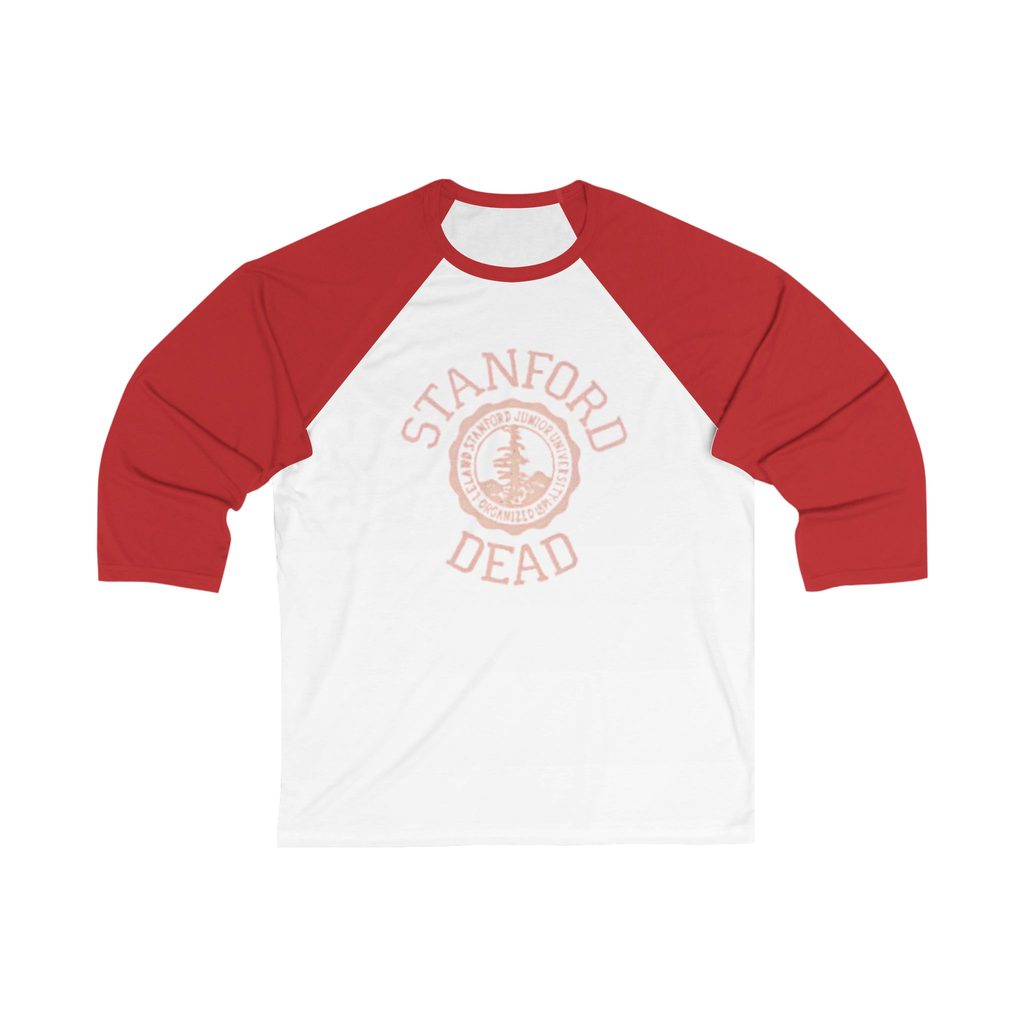
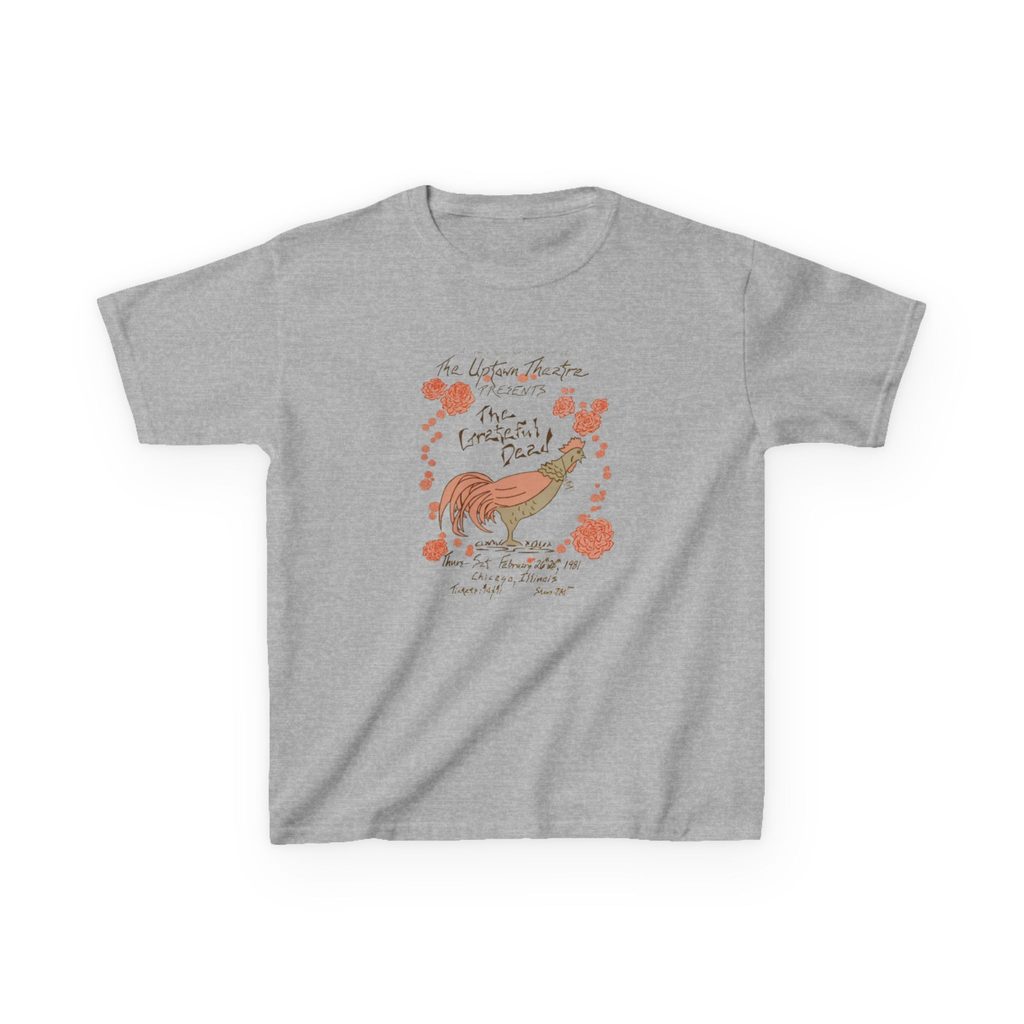
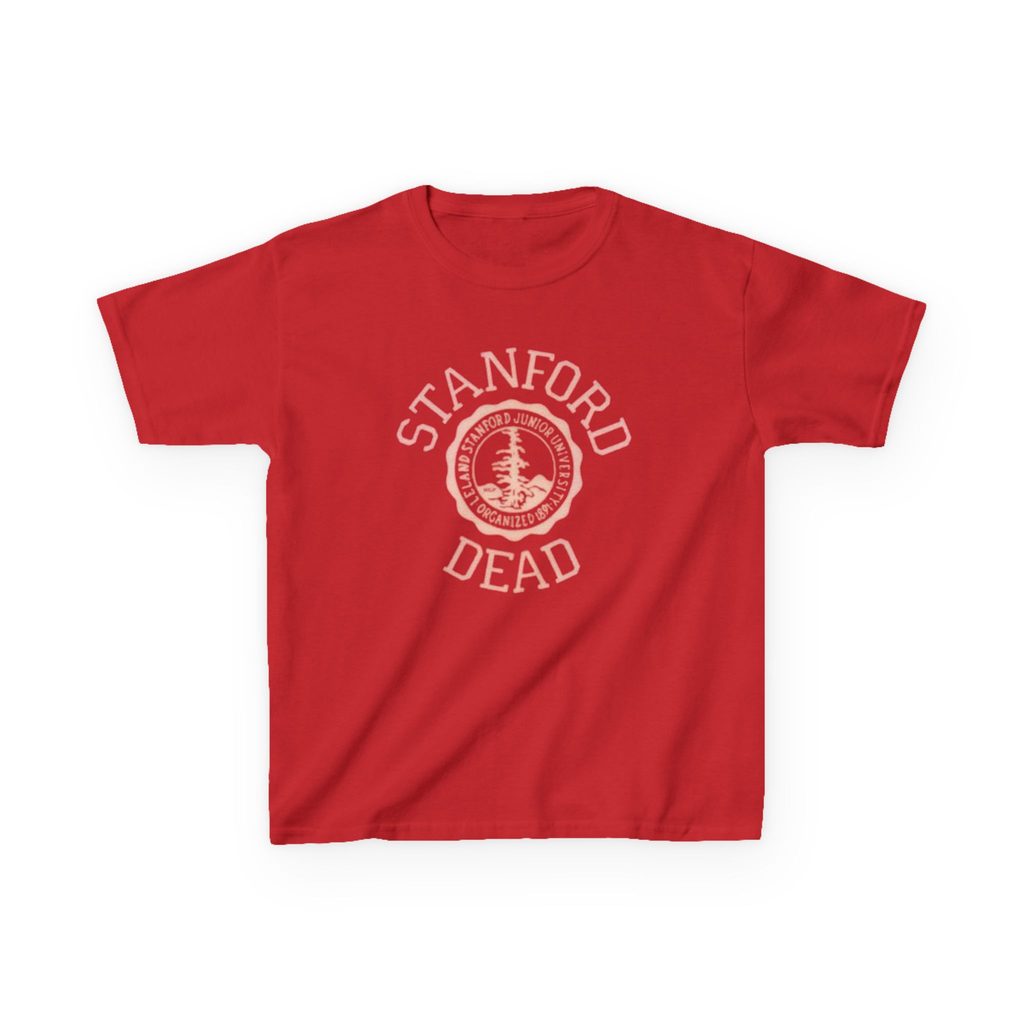
A few names anchor the collection: Philadelphia’s own Spectrum, the venue that defined a generation of Northeast concertgoing; the Valley Forge Music Fair, a touring institution in its own right; and a deep run of Grateful Dead pieces built around specific, storied moments, including the Stanford “Dead 1988” shows and the Watkins Glen Raceway run, one of the biggest gatherings in live music history.
A Few Places to Start
Spectrum Unisex 3/4 Sleeve Baseball Tee
Valley Forge Music Fair Unisex 3/4 Sleeve Baseball Tee
The Grateful Dead Stanford Dead 1988 Baseball Tee & Heavy Cotton Tee
The Grateful Dead Watkins Glen Raceway ComfortWash® Long Sleeve Tee
These aren’t costume-y reprints. The cuts and construction lean into the actual concertwear look of the era, so they read as lived-in rather than manufactured nostalgia. If any of these names mean something to you, or you’re just partial to the raglan-sleeve, road-worn look of vintage touring merch, this is the collection to dig through.
Animated spinoffs, new Netflix thrillers, theme park haunted houses, and a live-action spinoff on the way. The Stranger Things machine is running faster than ever.
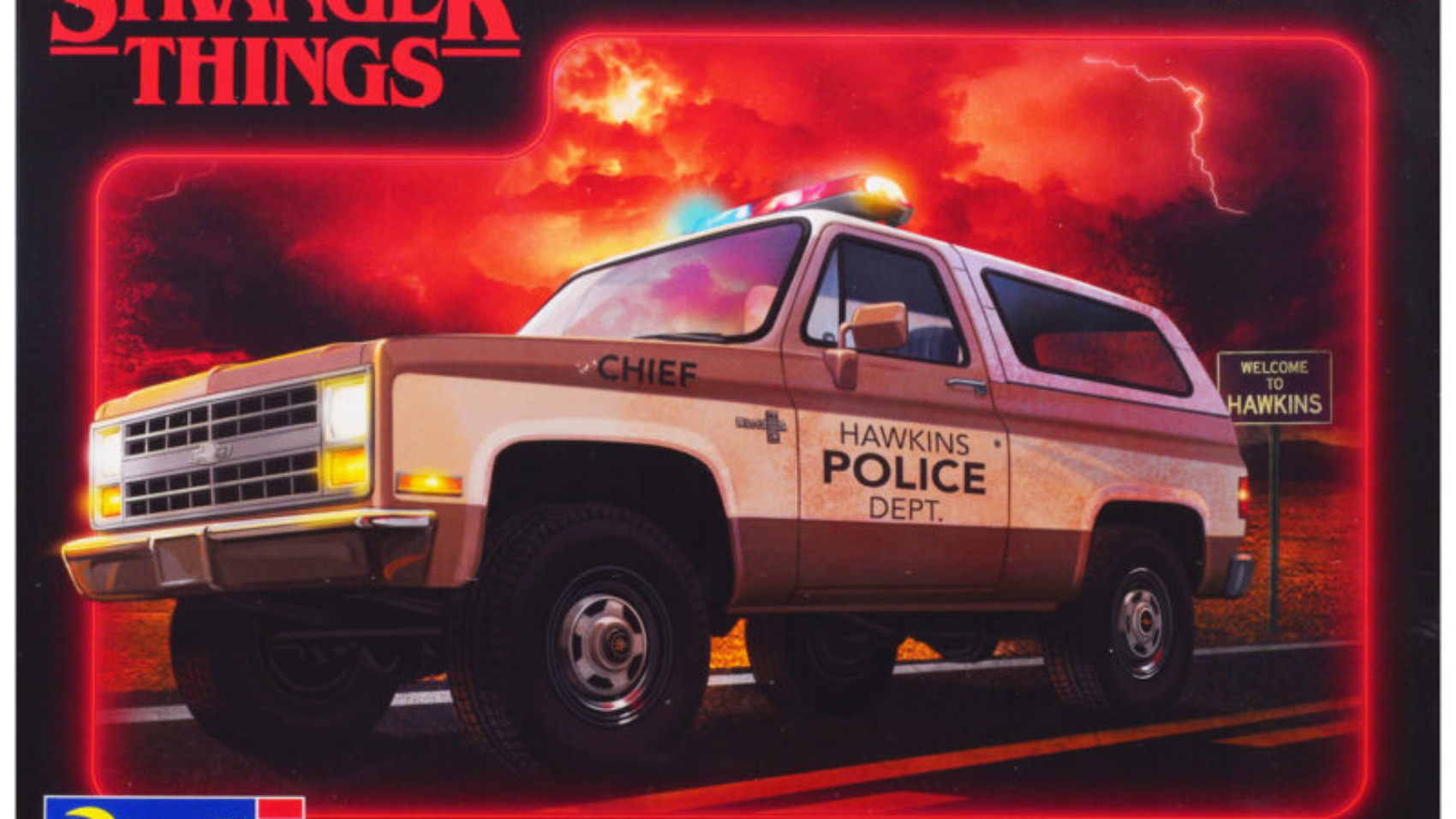
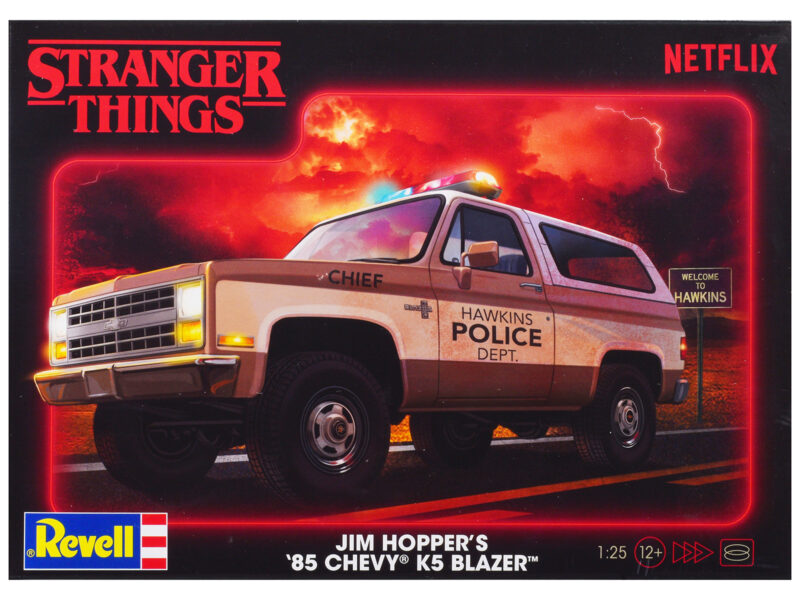
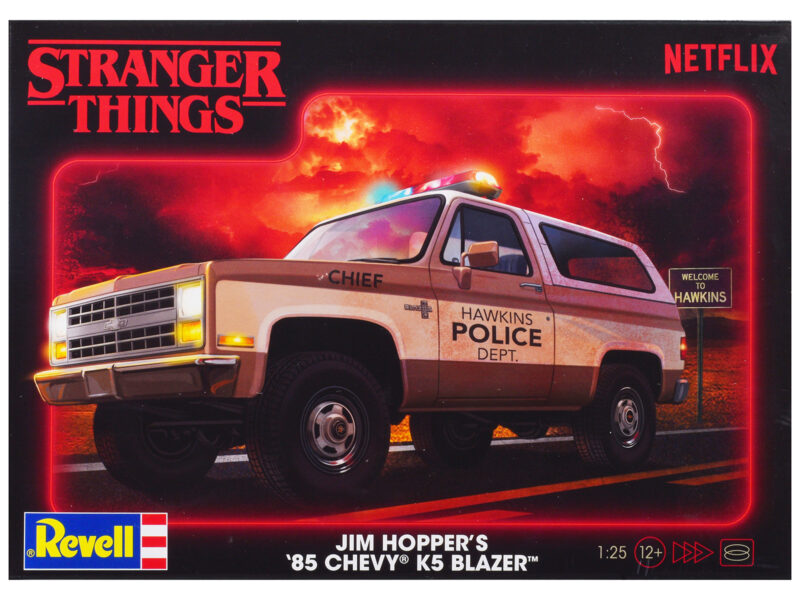
The Stranger Things universe is expanding in every direction at once. The animated spinoff Tales From ’85 Season 2 premieres September 17, Millie Bobby Brown and David Harbour are producing a brand-new Netflix thriller together, and the Duffer Brothers have a live-action spinoff in development focused on the deeper lore of the Mind Flayer. Plus: Rocky, MobLand, Knight Rider, and Walking Dead all have major news this week. Shop the full Stranger Things collection →
🎬 Stranger Things
Premieres September 17, 2026
Tales From ’85 Season 2 Is Here — and the Spinoff Universe Is Just Getting Started
Netflix’s animated spinoff Stranger Things: Tales From ’85 returns for its second season this Thursday, September 17, 2026, just five months after the show’s debut in April. That kind of turnaround bypasses the multi-year production gaps that defined the original live-action series, and it signals something important about how Netflix intends to keep Hawkins alive between major releases. The new 10-episode arc is set during the winter of 1985, landing between the events of live-action Seasons 2 and 3, and follows the Hawkins Investigators Club dealing with Valentine’s Day chaos, ghostly apparitions, and a swarm of creatures the show is calling hate sprites. It’s a weirder, more playful chapter than the season premiere suggested the show would attempt, and that’s a good thing. Meanwhile, Millie Bobby Brown and David Harbour are executive producing and starring in a brand-new untitled Netflix thriller about a disgraced FBI agent searching for his missing daughter. Harbour has confirmed the first two scripts are in hand. The Duffer Brothers remain attached to a separate live-action spinoff featuring an entirely new cast and time period, focused on the deeper mythology of the Mind Flayer. And Universal Studios Hollywood just opened a dedicated Stranger Things 5 haunted house at Halloween Horror Nights, modeled on the Upside Down. On the personal side, Maya Hawke, who plays Robin Buckley, married singer Christian Lee Hutson earlier this year in a Valentine’s Day ceremony attended by several of her Stranger Things co-stars.
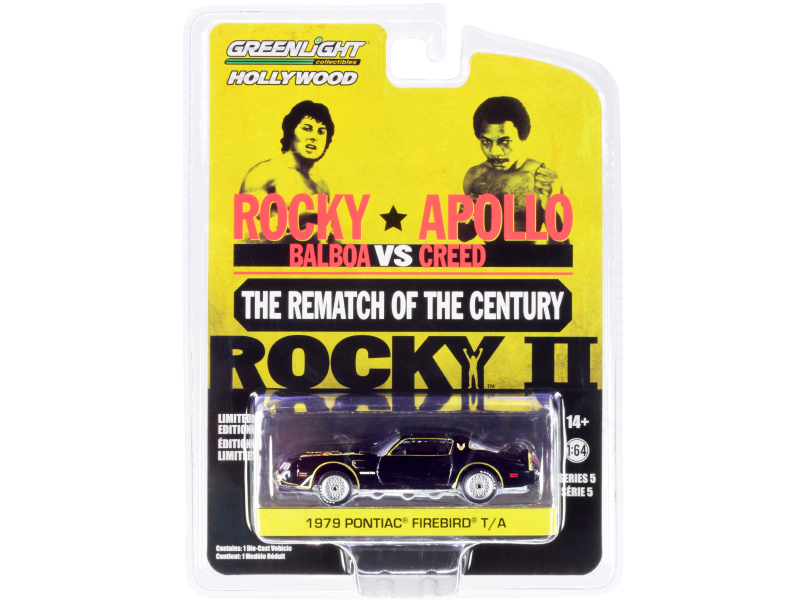
Director Peter Farrelly told Entertainment Weekly he was nervous when Stallone screened the biopic solo at his house. “He called right after,” Farrelly said. “He loved it.” Farrelly had made Stallone’s blessing a condition of making the film at all. Anthony Ippolito plays Stallone, Stephan James plays Carl Weathers as Apollo Creed, and Kiki Seto plays Adrian. The film follows Stallone’s early acting career through the creation of Rocky itself. Farrelly called the script “so darn good” that he knew the reaction would be positive.
Amid reports that Tom Hardy might not return for a potential MobLand Season 3, Pierce Brosnan made his position clear at the Season 2 premiere on September 10. “I love Tom Hardy,” he told the press. “I’m a massive fan of the man’s work.” He called the rumored tension “a storm in a teacup” and described the cast, which includes Dame Helen Mirren, as “rock solid as a company, as a family.” Video from the premiere showed Mirren and Hardy sharing a warm embrace on the red carpet.
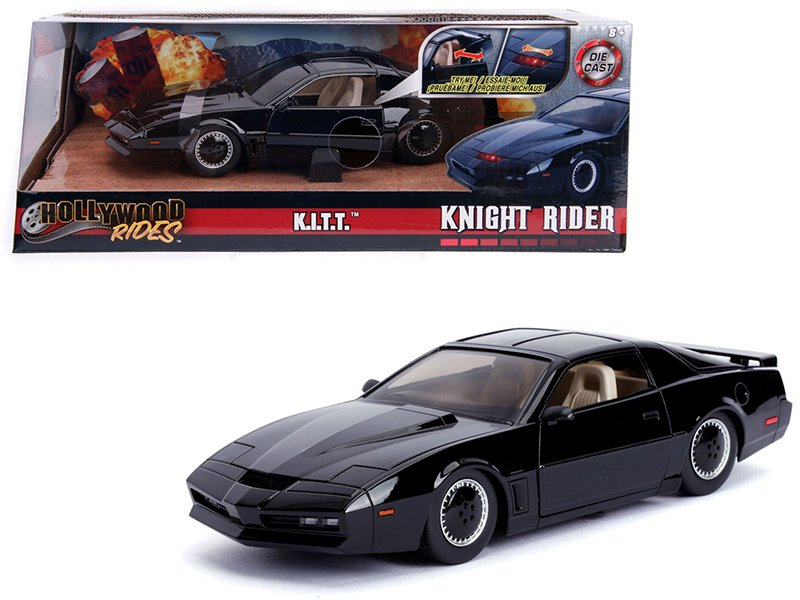
It has been 40 years since the finale of Knight Rider, the beloved NBC action series starring David Hasselhoff as Michael Knight and the AI-powered Pontiac Firebird known as KITT, voiced by William Daniels. The show ran four seasons and spawned spinoffs, TV movies, and revival attempts, but the original remains the one people actually remember. Hasselhoff went from the show straight to Baywatch, appeared in Guardians of the Galaxy Vol. 2, released 15 albums across four decades, and most recently starred in the travel docuseries Hoff Roading with Rhys Darby. The show belongs in the same conversation as The A-Team and Magnum P.I. as a defining piece of 1980s American television. And the franchise isn’t finished: Cobra Kai creators Jon Hurwitz, Hayden Schlossberg, and Josh Heald are developing a Knight Rider feature film. A talking car, a leather jacket, and a movie. It’s happening.
The Season 3 finale of The Walking Dead: Dead City ended with Negan stabbing Maggie as part of a tense gambit to fool antagonist Dillard, played by Jimmi Simpson, before Dillard was ultimately killed in a brutal confrontation. But it almost went differently. Jeffrey Dean Morgan, who serves as an executive producer on the series, pitched filming two versions of the finale, one where Dillard lives and one where he dies, specifically because he didn’t want to lose Simpson from the cast. “I didn’t wanna lose Jimmi,” Morgan told Entertainment Weekly. He brought the idea to Simpson, then to co-star Lauren Cohan, and then to showrunner Seth Hoffman. The dual-ending pitch didn’t go forward, and Dillard died with Negan at his side saying, “I hope you find what you’re looking for.” Morgan was also clear that Negan stabbing Maggie was not payback for their long, brutal history. It was survival strategy. The question now is what comes next for Negan in Season 4.
From a Linkin Park documentary to VMA record chases, a Beetlejuice threequel finally getting off the ground, and Middle-earth gearing back up — here’s what’s actually happening right now.
Music · Film & TV · The Buzz
This Week in Music, Movies, and Everything Else Worth Talking About
From a Linkin Park documentary to VMA record chases, a Beetlejuice threequel finally getting off the ground, and Middle-earth gearing back up — here’s what’s actually happening right now.
The Vending Lot · September 7, 2026
Music
Linkin Park’s Comeback Story Is Headed to Theaters
Linkin Park is closing out the summer with a new documentary rather than a new tour leg. “Unshatter,” directed by the band’s Joe Hahn, opens in theaters worldwide on September 30, tracing the group’s path from their return in 2022 through the making of “From Zero” and a pair of packed live shows in São Paulo. A companion live album, “Unshatter (Live From São Paulo),” lands five days earlier on September 25, giving longtime fans a full-catalog set with co-vocalist Emily Armstrong and drummer Colin Brittain, both now well into their second year with the band.
The 2026 MTV Video Music Award nominations are out, and Taylor Swift landed nine nods, including Video of the Year and Artist of the Year for “The Fate of Ophelia.” She’s currently tied with Beyoncé for the most VMA wins in history at 30, which means a single win at the September 27 ceremony would make her the outright record holder. Madonna actually leads the field this year with 11 nominations of her own, so it’s shaping up to be a real showdown between two generations of pop royalty.
Nothing’s confirmed, but Noel Gallagher isn’t exactly putting the rumors to rest either. In a radio chat this week, he pointed out there’s no major football tournament next summer, so the band has “got to do something.” Speculation has centered on a possible return to Knebworth and an extended homecoming stand at Manchester’s Etihad Stadium, following up on last year’s sold-out “Live ’25” reunion run that wrapped in São Paulo this past November. Take it as early smoke rather than a confirmed fire for now.
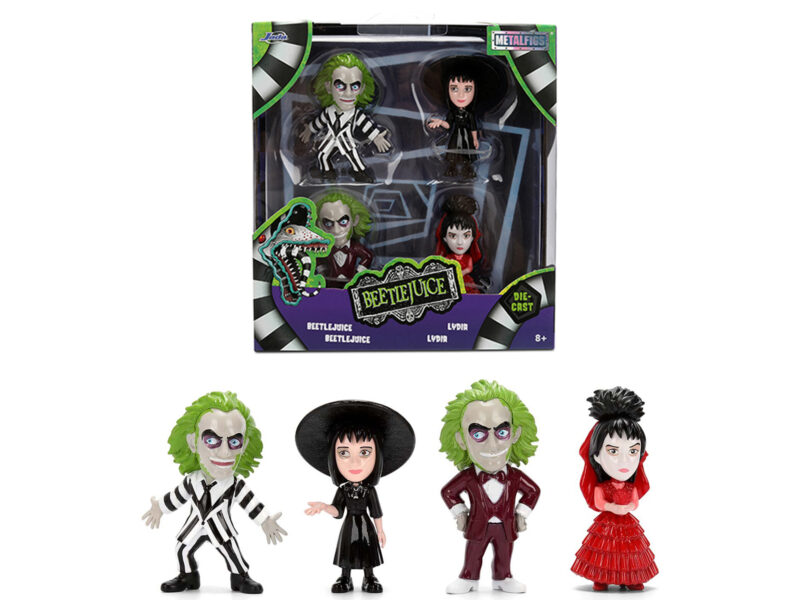
Warner Bros. has confirmed a third Beetlejuice film is in active development, building on “Beetlejuice Beetlejuice’s” massive $451 million worldwide haul back in 2024. Details are still thin, and Tim Burton has been cagey in interviews about whether he’s even attached, while star Jenna Ortega has said flatly she won’t sign on without him behind the camera. No script, cast, or release date locked in yet, so consider this one still simmering in the Netherworld.
Middle-earth fans got a fresh trailer at Comic-Con, and now the wait is almost over. “The Lord of the Rings: The Rings of Power” Season 3 premieres on Prime Video November 11 with an unusual rollout: four episodes drop together, two more follow a week later, and a two-episode finale closes it out on November 25. The story picks up five years after the fall of Eregion, with Sauron’s armies overrunning most of Middle-earth and only a handful of strongholds, including Khazad-dûm and Rivendell, still holding the line.
AC/DC Is Cruising Through American Stadiums, and Tonight It’s South Bend’s Turn to Get Thunderstruck
The Power Up World Tour rolls into Notre Dame Stadium tonight with The Pretty Reckless in tow, one more stop on a stadium run that wraps up at the end of September with back-to-back finales at MetLife and Lincoln Financial Field.
The Vending Lot · September 4, 2026
AC/DC’s Power Up World Tour has been filling stadiums across three continents since 2024.
Tonight, roughly 60,000 fans will pack into Notre Dame Stadium in South Bend, Indiana, for a band that first plugged in more than fifty years ago and still shows no sign of unplugging. AC/DC brings its Power Up World Tour to “The House That Rockne Built” this evening, September 4, with The Pretty Reckless opening, and doors set to open around 6 p.m. ahead of a 7:30 p.m. kickoff. It is one more stop on a run that has already crossed Europe, Australia, the UK, and South America since launching in Germany back in May 2024, and it is nowhere near finished.
The current North American leg picked back up on July 11 in Charlotte and has been steadily working its way through NFL and MLB stadiums ever since, hitting cities like San Antonio, Denver, Vancouver, Santa Clara, Edmonton, and Atlanta along the way. After tonight’s stop in South Bend, the tour heads to St. Louis on September 8, then Montreal, Toronto, and Winnipeg before crossing back into the U.S. for a pair of marquee closing shows: MetLife Stadium in East Rutherford, New Jersey on September 25, and Lincoln Financial Field in Philadelphia on September 29, which is set to close out the tour’s North American run entirely.
The band’s lineup for this run pairs the two names most fans associate with AC/DC’s classic era, guitarist Angus Young and vocalist Brian Johnson, alongside rhythm guitarist Stevie Young, with bassist Chris Chaney and drummer Matt Laug rounding out the touring band. Together they’ve been delivering a set that leans heavily on the catalog everyone shows up for, while still making room for cuts from 2020’s “Power Up,” the album that gave this whole tour its name.
What South Bend Can Expect Tonight
Fans who’ve caught the tour earlier this summer describe a show built for a stadium: full pyrotechnics, a giant inflatable set piece for one of the encore numbers, and a setlist that has stayed remarkably consistent from city to city all summer long. Openers The Pretty Reckless have been on the bill for every North American date, giving early arrivals a strong warmup act before the headliners take over.
What AC/DC has been playing most nights on this leg
If You Want Blood (You’ve Got It)
Back in Black
Demon Fire
Shot Down in Flames
Thunderstruck
Have a Drink on Me
Hells Bells
Shot in the Dark
Stiff Upper Lip
Highway to Hell
Shoot to Thrill
Sin City
Jailbreak
Dirty Deeds Done Dirt Cheap
High Voltage
Riff Raff
You Shook Me All Night Long
Whole Lotta Rosie
Let There Be Rock
T.N.T. (encore)
For Those About to Rock (We Salute You) (encore)
Fifty years in and they’re still filling stadiums with the same handful of chords that started it all.
A Tour That Just Keeps Rolling
What makes this run notable isn’t just the size of the crowds, it’s the stamina behind it. The Power Up World Tour has now stretched across six legs and roughly ninety shows since 2024, working its way through Europe, Australia, the UK, and a South American run earlier this year before three Mexico City dates in April set up the current U.S. and Canada leg. Very few bands from AC/DC’s era are still capable of headlining stadiums at this pace, and the ticket demand this summer suggests the appetite for it hasn’t slowed down one bit.
With just a handful of dates left before the Philadelphia finale on September 29, this stretch of shows has the feel of a victory lap for a band that’s been doing this since 1973. Whether you’re catching the show in South Bend tonight or just watching the tour roll through your city’s stadium on the schedule, it’s a rare chance to see a genuine rock institution still operating at full volume.
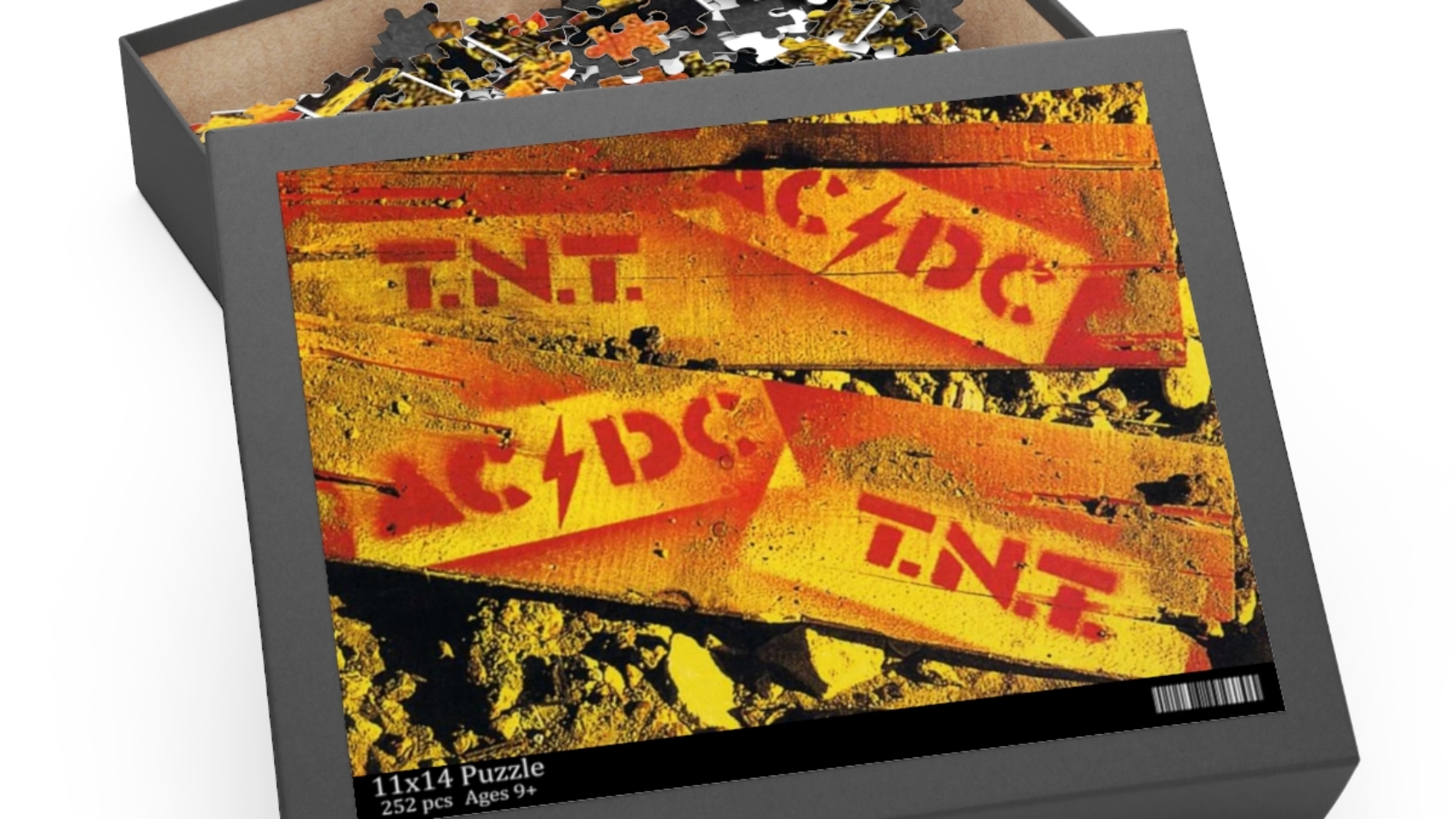
Gearing up for tonight’s show or just riding the wave of Power Up Tour excitement from home? The AC/DC gear in our merch stand is a good place to start.
Power Up Your Collection
A few ways to bring the tour home before the encore ends.
Ted Lasso Is Finally Coming Home, and This Time He’s Coaching the Team Nobody Expected
Season four hands Richmond’s biggest optimist a second division women’s club instead of the familiar men’s dressing room, and after three years of waiting, that gamble is the best decision this show has made since the pilot.
Sunset Daily Staff · August 1, 2026
Three years is a long time to miss a fictional football club, longer still when nobody at Apple gave a real reason for the wait beyond vague talk of a new creative direction. Ted Lasso went quiet in 2023 carrying a shelf of Emmys and a reputation as the one comfort watch nobody felt embarrassed to recommend at a dinner party, and it returns worldwide on August 5 with a twist the marketing team clearly wanted kept under wraps for as long as humanly possible. Ted is not coaching AFC Richmond’s men anymore. He is coaching a second division women’s club that barely existed in the show’s universe a year ago, and the entire fourth season is betting on that pivot landing.
The rollout started for real on July 27, when Apple staged the season’s official premiere at the Academy Museum of Motion Pictures in Los Angeles, a venue choice that tells you the studio still believes in this show’s cultural weight even after a long, unexplained gap. From there, the release follows the format longtime viewers already know. One episode arrives on launch day, and nine more follow it weekly every Wednesday, wrapping up on October 7. Apple has a habit of quietly dropping episodes the evening before at nine Eastern, so anyone who picked up on that pattern during earlier seasons already knows to check the app around dinnertime on Tuesdays rather than waiting for an official Wednesday morning.
Here is my honestly biased take before we go any further: moving Ted away from the men’s team is the right call, and not because women’s football needs a fictional American mascot to legitimize it, but because the original premise had nowhere left to go. Ted had already won over Roy Kent. He had already helped mend Rebecca’s heartbreak. He had already turned a mediocre men’s squad into promotion contenders. Repeating that exact arc with a few new faces in the same locker room would have felt like a victory lap dressed up as a fourth season. Handing him a second division women’s team, underfunded and overlooked in almost the same way the men’s side once was, gives the show an actual reason to exist again instead of just a contractual reason to air.
The Reunion, and the Absence That Still Stings
The returning names read like a reunion nobody had to fight for. Hannah Waddingham comes back as Rebecca Welton, Juno Temple returns as Keeley Jones, Brett Goldstein is still Roy Kent, Brendan Hunt keeps his post as Coach Beard, and Jeremy Swift remains the club’s endlessly put-upon Director of Football Operations, Leslie Higgins. None of that was ever really in doubt, and it shouldn’t have been. What was less certain, and what still stings a little for longtime fans, is who did not make the trip back to Richmond this time.
Phil Dunster is not on the call sheet this season. His character, Jamie Tartt, carried one of the show’s better redemption arcs across the first three seasons, and his absence traces back to a scheduling conflict tied to a new HBO comedy rather than any creative falling out, though the door has reportedly been left open for a limited cameo somewhere down the line. Dani Rojas and Sam Obisanya step back into supporting roles at best, since the men’s side of AFC Richmond is no longer where the cameras are pointed. That is a real loss, and pretending otherwise would be dishonest. But it also tells you how serious the show is about the reset. You cannot claim a genuine fresh start while keeping every familiar face crowded into the frame.
Filling that space is a roster built specifically for this version of the story. Tanya Reynolds joins as Alice Chilton, the co-coach who will presumably spend the season teaching Ted things about the women’s game he doesn’t already know, while Jude Mack, Faye Marsay, Abbie Hern, and twin performers Aisling Sharkey and Rex Hayes round out the new squad, known within the show as the Lady Greyhounds. None of these names arrive with the built-in goodwill of a Roy Kent or a Rebecca Welton, which means the first two or three episodes are doing real work introducing a locker room from scratch. That is a much harder sell than a returning-favorites victory lap, and it is exactly why this season interests me more than a fourth run at the same men’s team story ever could have.
A show that already made audiences cry over a dart game does not need the same locker room to pull that off a second time.
There is also talk, not yet fully confirmed by Apple itself but circulating with enough consistency to take seriously, that Jason Sudeikis has mapped out a full three-season arc for this new era of the show, with a writers’ room for season five reportedly set to open before the end of August. If that timeline holds, it suggests Apple isn’t treating the Lady Greyhounds as a one-off experiment to gauge audience appetite. It’s treating them as the show’s actual future, which reads as either a bold vote of confidence or a genuinely expensive bet, depending entirely on how the ratings settle over the next ten weeks.
Why I Think This Version Wins
What ultimately makes me optimistic, and I’ll admit this is closer to hope than hard analysis at this point, is that Ted Lasso earned its reputation by refusing to be cynical about people trying their best inside a system stacked against them. That description fits an underfunded second division women’s club far better than it ever fit a Premier League men’s side with money and history behind it. If the writers trust that instinct instead of chasing the exact emotional beats that worked the first time around, this season has a real shot at becoming the version of the show that finally lives up to everything people claimed it was back in 2020, rather than a nostalgic rerun with a new sponsor stitched onto the kit.
Ten weeks from now we’ll know whether the bet paid off. Until then, Richmond’s most devoted supporters have plenty of ways to show up for the Lady Greyhounds before episode one even airs, and the kind of gear that’s followed this fandom since the beginning is a good place to start.
Christopher Nolan just crossed $700 million globally in 12 days. Tom Holland is hinting he’ll play Spider-Man forever. The Willy Wonka anniversary is bringing Gene Wilder back to theaters in 4K, including in New Jersey. This is one of those weeks in Hollywood where everything seems to be happening simultaneously, and if you follow film culture with any seriousness, you already know the feeling. The Vending Lot’s Film Studio Lot is the place where that passion translates into something physical, something you can own, display, and keep long after any given opening weekend becomes a memory.
The box office numbers, the trailer drops, the industry controversies, and what all of it means for the people who love movies not just as content but as culture. Tune in. It’s going to be a full hour.
But right now, let’s talk about what’s happening in Hollywood this week and why the Film Studio Lot is the right place to be paying attention.
The Odyssey Is Rewriting the Rules
$700 million globally in 12 days. Let that sit for a moment. Christopher Nolan’s adaptation of Homer’s epic pulled $87 million this past weekend alone against a $304 million domestic cumulative total, which puts it on a trajectory that very few films in the history of cinema have matched at this pace. It’s doing this while simultaneously drawing pointed criticism from classical scholars and translator Emily Wilson, whose celebrated 2017 English translation of The Odyssey brought the poem to a new generation of readers and who has been publicly vocal about her concerns regarding the screenplay’s handling of the source material. That tension between commercial success and scholarly objection is exactly the kind of cultural friction that makes a film interesting beyond its opening weekend, and it’s the kind of conversation that will be happening for years.
The Film Studio Lot doesn’t carry an Odyssey collection yet, but it does carry the properties that define what serious film collecting looks like across multiple genres and eras. And right now, with the biggest cinematic story of the summer unfolding in real time, there’s no better moment to think about what you actually want on your shelf.
Spider-Man Is Back and Tom Holland Isn’t Going Anywhere
Early screening reactions for Spider-Man: Brand New Day are coming in warm, and Holland’s public comments about the role signal something that Marvel fans have quietly been hoping for: he’s not done, he’s not burned out, and he appears to be genuinely excited about where this fourth film takes Peter Parker. The film opens July 31, and the tracking numbers suggest a massive global opening weekend is likely. It’s directed by Destin Daniel Cretton, written by Chris McKenna and Erik Sommers, and features Jon Bernthal as the Punisher, Michael Mando as the Scorpion, Mark Ruffalo as Bruce Banner, and Sadie Sink in her MCU debut.
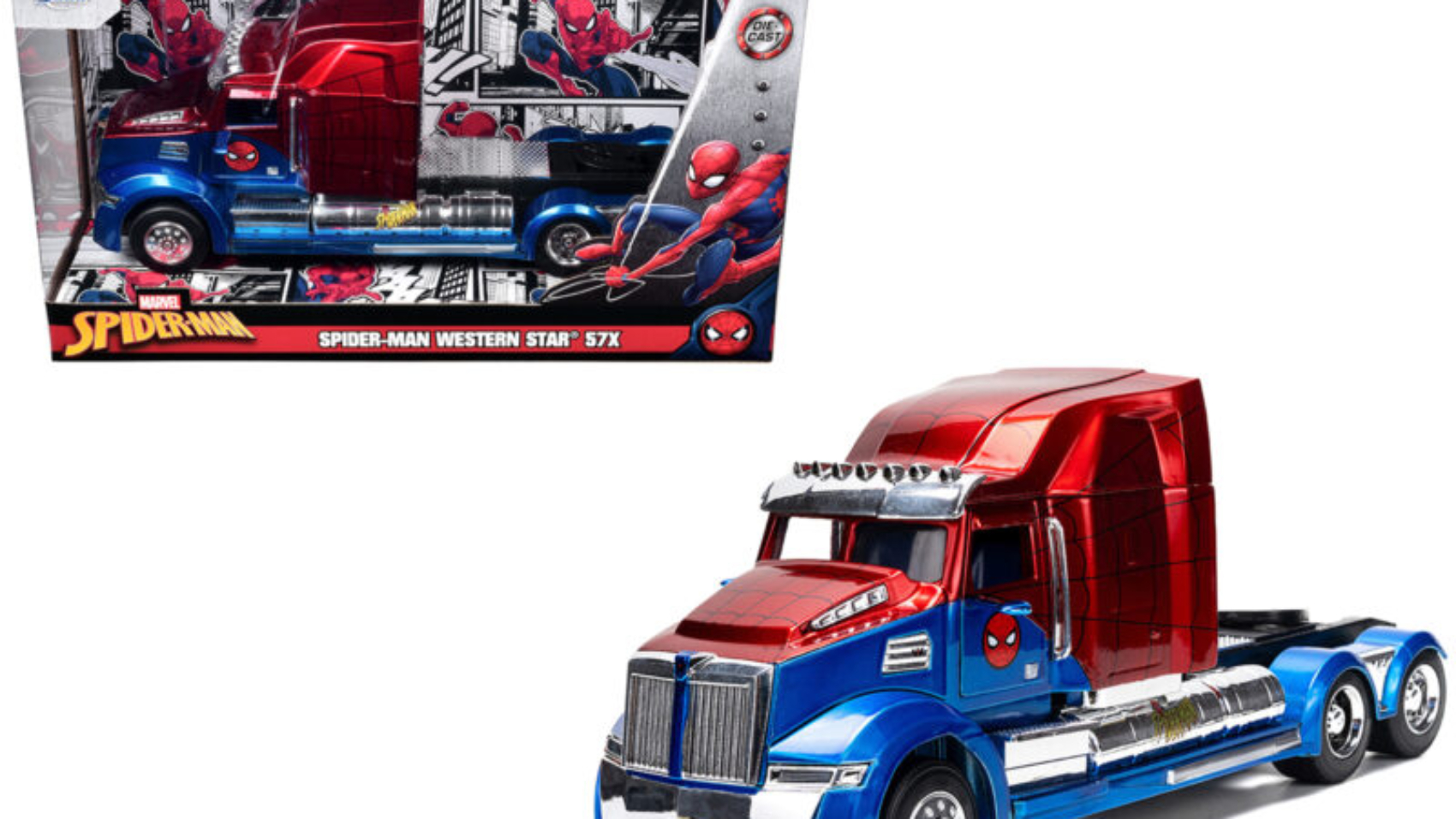
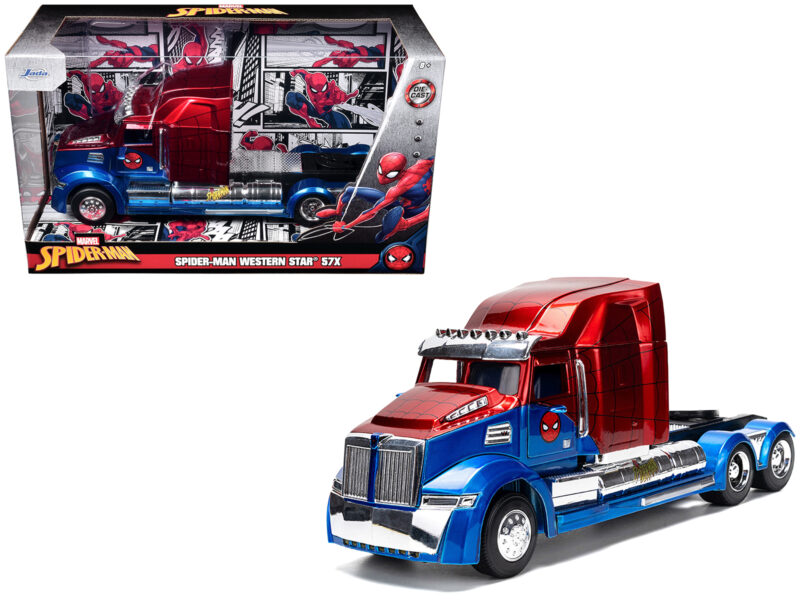
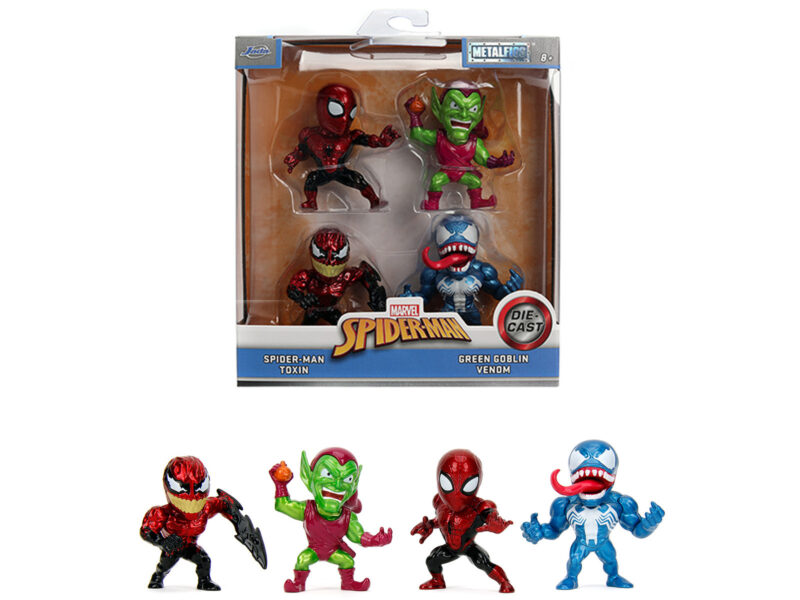
The Film Studio Lot’s Spider-Man section has the collector’s pieces for this moment: Jada’s 1/24 scale Western Star 57X truck tractor in Spider-Man’s blue and red metallic at $51.99, the 1/32 Porsche 911 GT3 RS at $17.86, the Wave 3 Metalfigs four-figure set at $37.10, and two poker card variants at $19.98 each. These are the pieces that connect a fan’s physical collection to the cultural moment happening right now at theaters worldwide. You don’t buy a Spider-Man collectible because you saw a movie. You buy it because the character means something to you, and these pieces are built to reflect that.
Jumanji, Thomas Crown, and the Trailers Everybody Is Talking About
Sony dropped the first official trailer for Jumanji: Open World this week, reuniting Dwayne Johnson, Kevin Hart, and Jack Black for the franchise’s third installment. The original 2017 reboot was one of the more surprising commercial successes of that year, and the 2019 sequel held its own. A third film is a genuine risk in a franchise environment where the audience’s appetite for sequels is increasingly unpredictable, but Johnson, Hart, and Black are a combination that has a documented chemistry on screen, and the trailer’s reception has been strongly positive across social media.
Amazon MGM released the first official look at a reimagined Thomas Crown Affair starring Michael B. Jordan in a role that positions him as a leading man in the heist thriller genre rather than in the action-drama space where most of his biggest recent work has landed. The original 1999 Thomas Crown Affair with Pierce Brosnan is the kind of stylish, character-driven studio film that doesn’t get made as often anymore, and Jordan’s version appears to be attempting to revive that specific mode of filmmaking. It’s one of the more interesting studio bets of the fall season.
The Film Studio Lot covers properties across the full spectrum of what cinema produces, from blockbuster franchise entries to prestige independent releases to the classic era films that defined the language of American moviemaking. The Mission Impossible section, the James Bond 007 collection spanning individual films across the entire franchise, the Back to the Future lineup, the Marvel Studios section with individual character collections for Captain America, Iron Man, Thor, Doctor Strange, and dozens more: the breadth of what’s available reflects a genuine commitment to film culture rather than simply stocking whatever happens to be trending.
Willy Wonka in 4K, in Theaters, in New Jersey
This one genuinely matters. Warner Bros. and Fathom Events are bringing the 1971 Willy Wonka and the Chocolate Factory back to theaters in a digitally remastered 4K presentation to mark its 55th anniversary, with a special retrospective introduction included in the limited engagement screenings at major national chains. Several of those screenings are happening at locations across New Jersey, which makes this a local opportunity that deserves a specific mention.
The 1971 film, directed by Mel Stuart and starring Gene Wilder in the defining performance of his career, is one of those properties where the gap between what the film actually is and how it’s typically discussed has always been interesting. Most people remember it as a children’s movie. Watch it again as an adult and it reads as something considerably stranger and more specifically unsettling, a film that seems to be operating in a register that sits just slightly outside normal children’s entertainment, which is exactly why it has sustained its cultural presence across five decades and two remake attempts. Wilder’s performance is the reason. It’s not a performance designed to be reassuring to children. It’s a performance designed to be genuinely unpredictable to everyone, and that unpredictability is what gives the film its staying power.
The Vending Lot’s Film Studio Lot carries Willy Wonka merchandise within the broader Warner Bros. and classic film catalog sections, and the 55th anniversary theatrical run is the right moment to own something that connects you to the property in a physical way. The 4K remaster in a theater environment, on an actual screen with actual sound, is a genuinely different experience from a streaming watch, and if you’re in New Jersey and can make it to one of the screenings, it’s worth the trip.
What’s Streaming This Week
Ted Lasso is coming back. Jason Sudeikis revealed the official trailer for a confirmed fourth season, and the creative decision to reposition the series around women’s soccer signals that the show isn’t simply recycling its original premise. The first three seasons built one of the most genuinely warm and emotionally intelligent series in recent streaming history, and a fourth season that extends the premise into new territory while keeping the character’s essential optimism intact is a promising direction. It lands on Apple TV+ later this year.
Netflix dropped the Outer Banks Season 5 trailer, which the show is positioning as the final treasure hunt for the Pogues. The series has run longer than most of its genre peers and maintains a devoted fan base that has followed the cast through multiple increasingly elaborate adventure storylines. A fifth and final season that delivers a satisfying conclusion to the treasure narrative is what the audience is hoping for, and the trailer suggests the production is taking that responsibility seriously.
Hulu shared a fall release date and first look footage for Chad Powers Season 2, the Glen Powell-led football comedy that found a strong audience in its first season largely on the strength of Powell’s considerable comic charisma and the show’s willingness to lean into the absurdity of its premise rather than trying to make it respectable. Season 2 expands the supporting cast and appears to push the central character further into situations where the disguise that drives the show’s premise becomes increasingly difficult to sustain.
The Box Office, Ranked
The Odyssey led the weekend with $87 million, bringing its domestic total to $304 million and its global number past $700 million. Moana held well in its fourth weekend with $10.5 million for a $104 million cumulative domestic run, which positions it comfortably within the range of a successful Disney live-action theatrical release. Toy Story 5 added $10 million to reach $450 million domestically, a number that confirms the franchise’s continued commercial vitality despite the longer gap between installments. The real surprise of the weekend was Hadestown: The Musical, which opened to $9.7 million against a $12 million cumulative total, suggesting that the theatrical adaptation of the Tony-winning Broadway musical is finding an audience beyond the existing fan base of the stage production. Minions and Monsters added $9.6 million for a $157 million total.
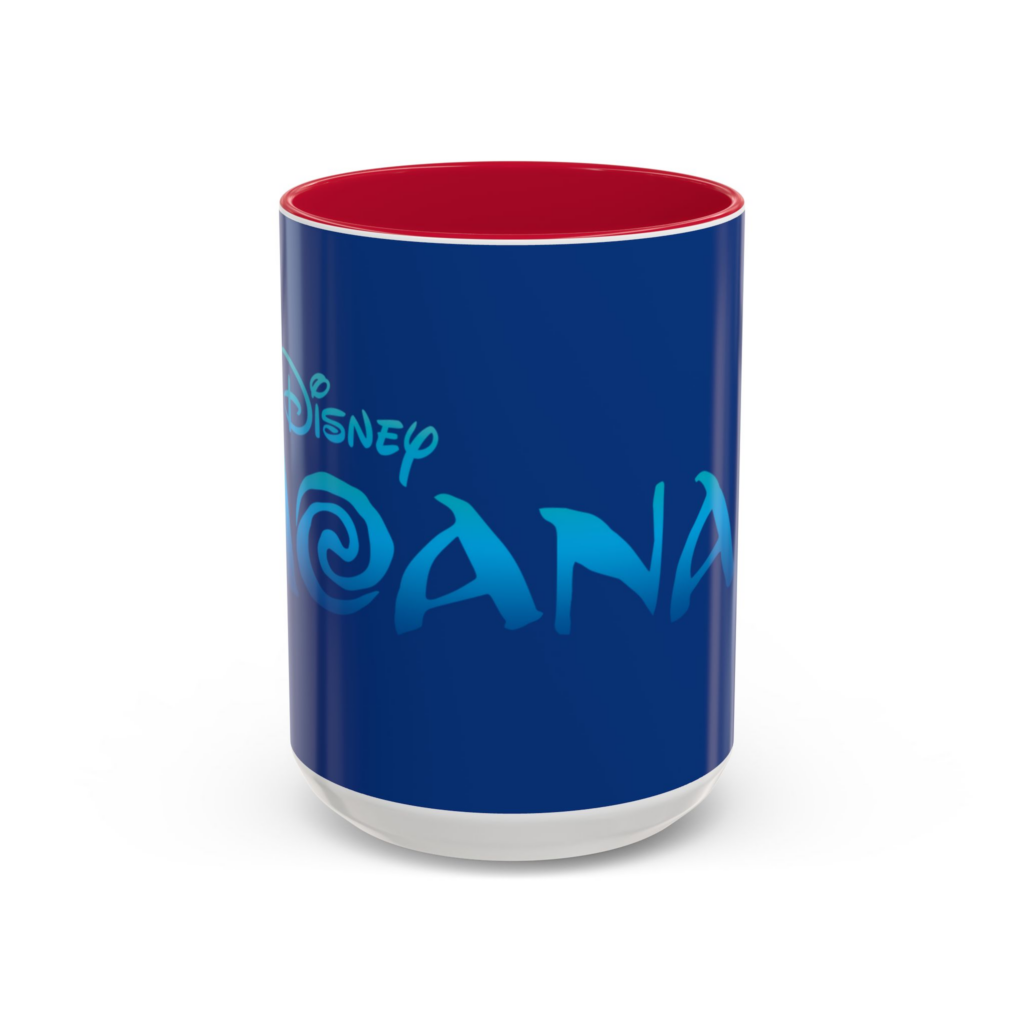
The Film Studio Lot carries official licensed merchandise for several of these properties. The Moana collection is live and stocked with 13 products timed to the theatrical run. The Disney section covers the broader Walt Disney Pictures catalog across multiple eras. For the properties currently in theaters and driving this weekend’s numbers, the Film Studio Lot is where the fan merchandise lives for the collectors who want to connect their physical collection to the cultural moment.
Industry News You Need to Know
Jared Leto issued a public statement this week calling allegations made in a BBC documentary “categorically false.” The documentary raised accusations of sexual misconduct, and Leto’s denial was immediate and emphatic. The situation is ongoing and will likely generate continued coverage as responses from the network and documentary filmmakers emerge.
BTS has confirmed they won’t be submitting music for consideration at the 2027 Grammy Awards. The decision is significant given the group’s enormous global following and the ongoing conversation within the K-pop community about how American music industry institutions engage with international artists. The Grammy organization has not publicly responded to the announcement.
The entertainment world lost two genuinely significant figures this week. Glen Hansard, who won the Academy Award for Best Original Song for Falling Slowly from the 2007 film Once, died at 56. Hansard was not just an Oscar winner but a deeply respected live performer and songwriter whose work with The Frames and his ongoing solo career built a following that went well beyond the film that made him internationally known. Kavinsky, the French electronic music producer and artist whose 2013 track Nightcall, featured prominently in the film Drive, became one of the defining sounds of a specific moment in electronic music production, died at 50. Both losses are genuinely felt across communities that cared about the specific kind of artistry each represented.
The Film Studio Lot: Built for Serious Collectors
Here’s the honest pitch for why the Vending Lot’s Film Studio Lot is worth your time as a collector: it’s not trying to be everything to everyone. It’s curated around the films and franchises that have genuinely mattered to the people who care about cinema, across multiple generations and multiple genres, and it carries merchandise that reflects that care in the quality of the products themselves.
The James Bond 007 collection spans individual films from Dr. No through the Daniel Craig era, with 46 products covering more than 60 years of the franchise’s history. The Fast and Furious section carries 105 products, the largest individual franchise collection in the store, reflecting both the franchise’s enormous commercial reach and the genuine collector enthusiasm it generates. The Batman section carries 35 products across the TV and film iterations of the character. The Happy Gilmore and Happy Madison sections carry 35 and 36 products respectively, a reflection of the store’s commitment to comedy properties alongside its superhero and action-adventure offerings. The Fantastic Four section carries 54 products timed to the current theatrical release. The Despicable Me section has 35 products. The Wicked section carries 54 products in recognition of the musical’s theatrical and streaming success.
The Film Studio Lot also carries some of the more unexpected and specifically beloved properties in the licensed merchandise space. The This is Spinal Tap section has 46 products, the Springsteen: Deliver Me from Nowhere section has 36, the Running Man section has 37, and Kingsman: The Golden Circle carries 25. These aren’t the obvious franchise choices. They’re the properties that a genuine film culture audience actually wants merchandise for, not just the properties that dominate global box office charts.
[Your story here about the film that made you want to own something connected to it, whether that was a poster, a diecast vehicle, or a piece of clothing.]
The TV Studio Store mirrors that philosophy across television, with more than 1,250 products covering scripted series from the classic network era through contemporary streaming. The Merch Stand covers music across more than 250 artists. On Broadway serves the stage production audience. Funko Town brings collectible vinyl figures together from across the entertainment world. The Vending Lot newsletter on Substack is where the deeper conversations about new arrivals, collection features, and cultural context happen between broadcasts.
The box office, the trailers, the industry news, and what it means for the people who love film culture seriously enough to collect it. Tune in, and shop the Film Studio Lot while the week’s biggest stories are still unfolding.
There is a short list of brands whose visual identity is so deeply embedded in global culture that the mere sight of a specific shade of red, a particular curve of a glass bottle, or a single flowing script of lettering can produce an immediate and involuntary sense of recognition across languages, generations, and continents. Coca-Cola occupies a position on that list that no other beverage, and very few commercial entities of any kind, has ever matched. The brand did not achieve that position through advertising alone, though its advertising legacy is extraordinary. It achieved it through 140 years of consistent presence in the physical spaces of ordinary life, from the corner drugstore counter in 1886 Atlanta to the hands of American soldiers on the beaches of Normandy to the refrigerators of households in more than 200 countries today. That kind of cultural saturation produces exactly the kind of passionate collector community that The Vending Lot’s Coca-Cola collection was built to serve, and the 31 products currently available in the store represent one of the most precisely assembled Coca-Cola diecast and model kit collections available through any single online destination.
The products in this collection are not generic branded merchandise with a logo applied to a forgettable substrate. They are precision-engineered scale models and detailed diecast vehicles, produced by some of the most respected names in the collector’s hobby industry, rendered in the specific historical vehicles that carried Coca-Cola’s product and identity into the world across the twentieth century. Buying a piece from this collection is not simply acquiring a display item. It is acquiring a specific chapter of automotive and commercial history, presented at the quality standard that serious collectors have come to expect, carrying the visual identity of the single most recognized brand in the history of commerce.
To understand why these products carry the weight they do, it helps to understand what Coca-Cola actually is and how it got there, because the story behind the brand is as compelling as the vehicles and collectibles built to honor it.
The Birth of an Accidental Empire: Coca-Cola from 1886 to the Early Twentieth Century
Coca-Cola was invented on May 8, 1886, by Dr. John Stith Pemberton, a pharmacist practicing in Atlanta, Georgia, who came to the formula through a combination of scientific experimentation and personal necessity. Pemberton was a wounded veteran of the Civil War who had developed a severe morphine dependency as a result of his injuries, and his search for a less dangerous substitute led him to experiment with combinations of ingredients that included coca leaf extracts and kola nut derivatives. The syrupy mixture he developed was originally positioned and marketed as a patent medicine and health tonic, claimed to combat fatigue and headaches, the two most common complaints that brought customers to the average American pharmacy counter of the era.
It was Pemberton’s bookkeeper, Frank M. Robinson, who gave the drink its name. Robinson identified the two primary structural ingredients, coca leaves and kola nuts, and combined their names to produce “Coca-Cola,” a designation that was as straightforward in its derivation as it was memorable in its sound. Robinson also created the flowing Spencerian script lettering that spelled out that name, a handwriting style that was widely taught in American business schools of the period and that produced the elegant, looping characters that remain, entirely unchanged, the visual foundation of the brand’s identity to this day. No other commercial logo in the world has survived 140 years of graphic design evolution without a single substantive modification.
The first commercial sale of Coca-Cola took place at Jacobs’ Pharmacy in downtown Atlanta, where the concentrated syrup was mixed with carbonated water and sold at the counter for five cents per glass. The price point was deliberate and the location was strategic: pharmacies were the social hubs of American consumer life in the late nineteenth century, and the soda fountain counter was where customers gathered, socialized, and discovered new products. The carbonated water was not part of Pemberton’s original formula but was introduced at the pharmacy level as a preparation method, and the combination proved far more appealing than the straight syrup alone.
Pemberton sold the formula rights in 1888 to businessman Asa Griggs Candler for the sum of $2,300, a figure that has become one of the most frequently cited examples of undervalued intellectual property in the history of American commerce. Candler formally incorporated The Coca-Cola Company in January 1892 and set about transforming what had been a regional pharmacy curiosity into a national brand with extraordinary methodical effectiveness. One of his most important decisions came in 1903, when the formula was officially modified to remove all active trace amounts of cocaine from the coca leaf extracts used in production. The modification addressed growing public concern about cocaine’s effects while preserving the flavor profile that had made the drink commercially successful, and it allowed Coca-Cola to position itself as a family-appropriate refreshment rather than a medicinal product with potentially addictive properties.
The iconic contour bottle that became one of the most recognizable container shapes in the history of manufactured goods arrived in 1915, developed in partnership with the Root Glass Company as a direct response to the proliferation of imitators trying to trade on Coca-Cola’s success. The brief given to the designers was essentially that the bottle should be recognizable in the dark, by touch alone, even broken, and the curves that resulted from that specification have become as inseparable from the brand’s visual identity as the red label or the script lettering. Full mass production of the contour bottle began in 1916, and it remained the primary delivery format for the product for decades.
The franchised bottling model that Candler and his successors developed to scale the brand globally was, from an operational standpoint, as innovative as the product itself. Rather than building and operating its own bottling facilities across the country and eventually the world, the company sold its concentrated liquid syrup to independent local bottling plants and granted them exclusive regional territory rights to produce and distribute the finished carbonated beverage. This model allowed Coca-Cola to expand at a speed that would have been impossible through direct ownership while simultaneously building a network of committed local business partners whose financial success was directly tied to the brand’s continued strength. It is the same fundamental model that still underlies the company’s global distribution operation today.
From Atlanta to the Western Front: How Coca-Cola Became the World’s Drink
The transformation of Coca-Cola from an American regional product into a genuinely global brand accelerated through one of the most unlikely channels in the history of commercial expansion: warfare. During World War II, the company made the commitment to supply American military personnel with Coca-Cola at five cents per bottle regardless of where they were stationed or what the actual cost of production and delivery required, and to fulfill that commitment, it built 64 portable field bottling plants across Europe, Asia, and North Africa. Those plants operated in environments ranging from English countryside to Pacific island supply depots to North African desert installations, and the soldiers who drank from them carried the taste, the brand association, and the cultural meaning of Coca-Cola into the postwar lives they returned to in countries across the globe.
The portable bottling plants were not just logistical operations. They were brand installations, and the Americans who operated and consumed from them were, in effect, living advertisements whose personal testimonies and postcards home wove Coca-Cola into the story of American participation in the war in ways that no paid advertising could have produced. By the time the war ended and those soldiers came home or settled in the countries where they had served, Coca-Cola had achieved a kind of cultural penetration that a hundred years of normal commercial expansion might not have replicated.
The decades that followed saw Coca-Cola expand its product portfolio beyond the single original beverage that had made its name. Fanta, originally developed in Germany during the war years when American syrup imports were blocked by the economic disruptions of the conflict, was acquired by the company in 1946. Minute Maid, the leading American orange juice brand, came into the portfolio in 1960, representing the company’s first significant move beyond carbonated soft drinks. Sprite, developed internally as a clear lemon-lime alternative to 7Up, launched in 1961 and became one of the company’s most globally successful products. Diet Coke arrived in 1982, becoming one of the fastest-growing new beverage products in American history. Powerade entered the portfolio in 1992. Coke Zero Sugar, reformulated to more closely match the taste profile of the original product without its sugar content, launched in 2017.
The most famous product failure in the company’s history, the 1985 introduction of “New Coke,” is worth examining not as an embarrassment but as evidence of something remarkable about the brand’s relationship with its consumers. On April 23, 1985, after 99 years of selling the same formula, the company changed its original recipe, replacing it with a sweeter formulation that had tested better in blind taste studies than both the original and its primary competitor. The public reaction was not merely negative. It was visceral, organized, and relentless, generating more than 400,000 letters and phone calls of protest to company headquarters and producing a consumer backlash that had no precedent in American commercial history. Within 79 days, the company reversed course entirely, bringing back the original formula under the name Coca-Cola Classic. The episode demonstrated, more clearly than any marketing study could have, that Coca-Cola’s product was not just a beverage to its consumers. It was a relationship, an emotional connection, and a piece of personal history that they refused to surrender even to the company that owned the trademark.
Today, The Coca-Cola Company owns more than 200 global beverage brands spanning carbonated sodas, still waters, juices, coffees, teas, and energy drinks, making it one of the most diversified beverage businesses in the world while the original red-labeled product remains the commercial and cultural flagship of the entire enterprise. The formula, still secret, is stored at its permanent home at the World of Coca-Cola museum in Atlanta, having moved there from the bank vault where it resided for decades, and the brand’s global recognition continues to exceed that of any other commercial product on the planet.
The Collector’s Case for Coca-Cola Diecast and Model Kits
The intersection of Coca-Cola and automotive collecting is not an arbitrary one. Throughout the twentieth century, Coca-Cola built its delivery and distribution infrastructure on a fleet of vehicles that ranged from horse-drawn wagons and early Ford cargo vans to purpose-built beverage trucks and nationally recognizable tractor-trailers, and those vehicles became as much a part of the brand’s visual vocabulary as the bottle they carried. In American cities and towns from the 1920s through the 1960s, the sight of a red Coca-Cola delivery truck was as familiar as a traffic signal, and the vehicles themselves were maintained and presented with a pride that made them moving advertisements for the brand’s identity as much as its product. When those vehicles are rendered in precise miniature by skilled model manufacturers, they carry all of that historical and cultural weight into a format that sits on a shelf or in a display case and tells the story of American commercial history through the specific lens of one of its most compelling chapters.
The Vending Lot’s Coca-Cola collection draws from four major manufacturers: AMT, Polar Lights, MPC, and the Motor City Classics and Motorcity Classics lines from the same production family. Each manufacturer brings a distinct approach to the material, and understanding those differences helps any collector make informed decisions about which pieces belong in their collection and why.
AMT and MPC: The Model Builder’s Craft
The AMT and MPC products in The Vending Lot’s Coca-Cola collection represent the hands-on, build-it-yourself side of the collector’s experience, and they are specifically designated as Skill 3 model kits, meaning they are intended for modelers with some prior experience rather than complete beginners, but are entirely accessible to anyone willing to invest the time and attention the process requires. The exception is the Skill 1 Chevrolet K5 Blazer from MPC, which is the most approachable entry point in the model kit category.
The Skill 3 Model Kit 1940 Ford Sedan Delivery Van Coca-Cola with Display Base, 1/25 Scale by AMT is priced at $47.24 and represents one of the most historically significant vehicles in the entire collection. The 1940 Ford Sedan Delivery Van was a workhorse of American commercial distribution during the period when Coca-Cola was consolidating its dominance of the American soft drink market, and the 1/25 scale rendering captures the rounded, Art Deco-influenced body lines that made the vehicle visually distinctive on any street. The included display base makes this a particularly exhibition-ready piece once built. The Skill 3 Model Kit White Western Star Semi Truck Tractor Coca-Cola, 1/25 Scale by AMT at $61.54 is the most ambitious and visually commanding of the AMT model kits, a 1/25 scale semi tractor that represents the large-scale commercial distribution fleet that carried Coca-Cola across American highways in the brand’s more recent history. At 1/25 scale, the finished model has a substantial physical presence.
The Skill 3 Model Kit 1955 Chevrolet Cameo Pickup Truck Coca-Cola with Vintage Vending Machine and Dolly, 1/25 Scale by AMT at $44.38 is one of the most narratively complete pieces in the model kit category, because the inclusion of a vintage vending machine and dolly accessory transforms the finished model from a standalone vehicle into a small diorama that captures an entire moment in mid-century American commercial life: the delivery driver arriving with product, the dolly in hand, the vending machine waiting to be stocked. The 1955 Chevrolet Cameo was itself one of the most stylistically advanced pickup trucks of its era, combining the utility of a work vehicle with the exterior design sensibility of GM’s passenger car lineup at the height of the tailfin era. The Skill 3 Model Kit 1940 Willys Gasser Pickup Truck Coca-Cola, 1/25 Scale by AMT at $42.56 brings the Willys body style, famous from its military Jeep applications and beloved by the hot rod community for its compact proportions and modification potential, to the Coca-Cola livery in a combination that is distinctively American in its cultural references.
The Polar Lights entry in the model kit category, the Skill 3 Snap Model Kit Volkswagen Beetle Coca-Cola, 1/25 Scale at $40.74, deserves special attention for the snap-fit assembly method that eliminates the need for adhesives during construction. Polar Lights’ snap kits are a genuine achievement in model engineering, producing pieces that assemble with satisfying precision and hold their shape without gluing, making them particularly accessible for builders who want the satisfaction of the build process without the additional complexity of adhesive work. The VW Beetle in Coca-Cola livery is also one of the most visually coherent pairings in the entire collection, two globally recognized icons whose combined image feels completely natural.
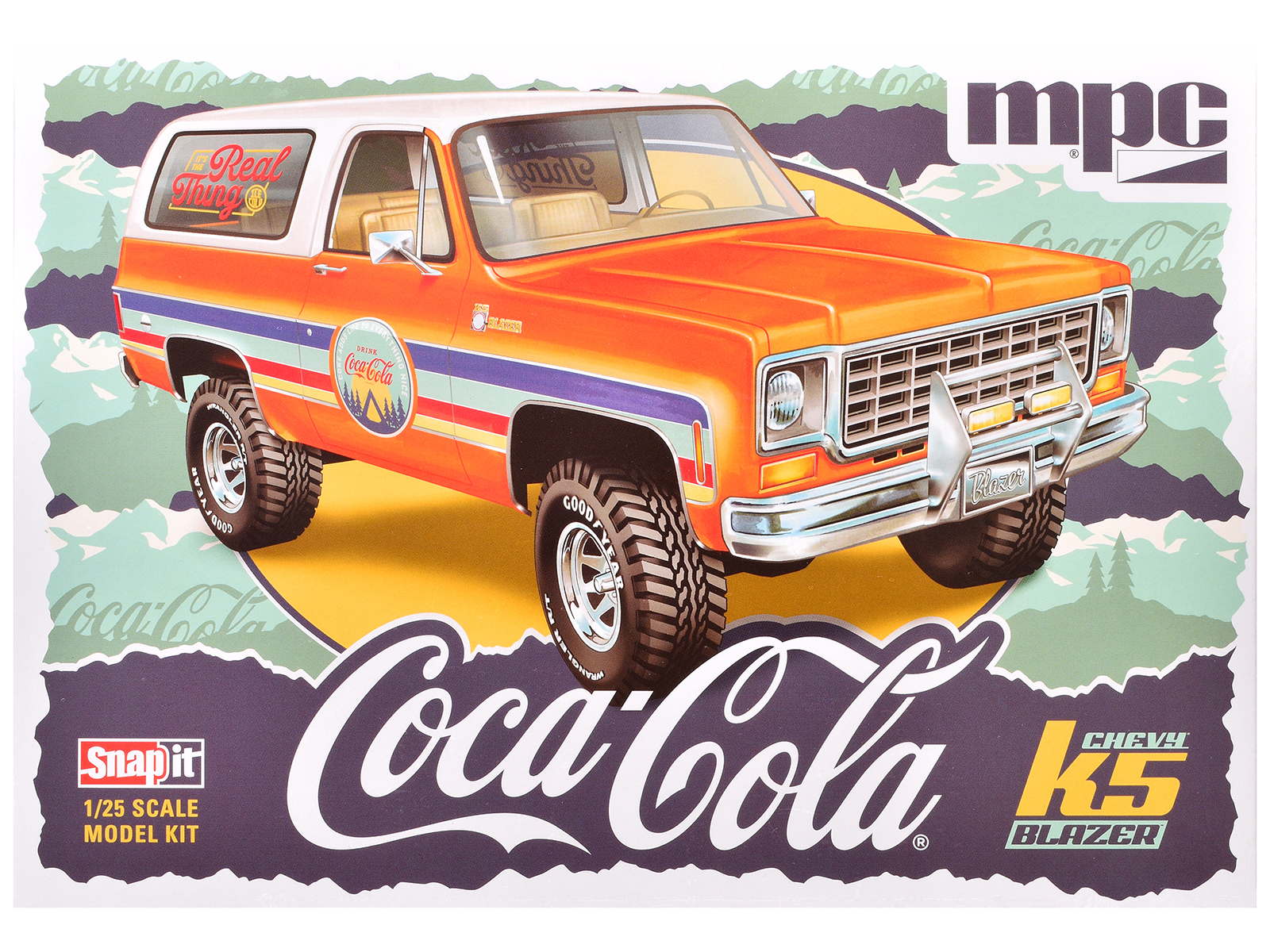
MPC’s two entries bring the classic American muscle and utility vehicle categories to the model kit side of the collection. The Skill 1 Model Kit Chevrolet K5 Blazer Coca-Cola, 1/25 Scale at $42.56 is the most beginner-accessible model in the entire lineup, with a Skill 1 designation that makes it a natural entry point for collectors new to the model building hobby who want to build something meaningful rather than something trivial. The K5 Blazer is also one of the most culturally resonant American trucks of its generation, a full-size four-wheel-drive vehicle that defined the recreational utility market through the 1970s and 1980s. The Skill 3 Model Kit 1932 Ford Sedan Delivery Coca-Cola, 1/25 Scale by MPC at $40.74 takes the collection back to the depths of the Depression era, when the 1932 Ford was one of the most technically advanced and visually distinctive vehicles on American roads. The Sedan Delivery body style is particularly collectible in model form because it represents a commercial application of a passenger car platform that was common in the period but has almost entirely disappeared from modern commercial vehicle design.
Motor City Classics and Motorcity Classics: The Ready-Display Diecast Collection
The ready-to-display diecast models from the Motor City Classics and Motorcity Classics lines make up the majority of The Vending Lot’s Coca-Cola collection and offer the broadest range of scale, vehicle type, price point, and historical era of any segment of the lineup. These are finished pieces, requiring no assembly, produced with precision casting and paint application that allows them to go directly from the box to the shelf.
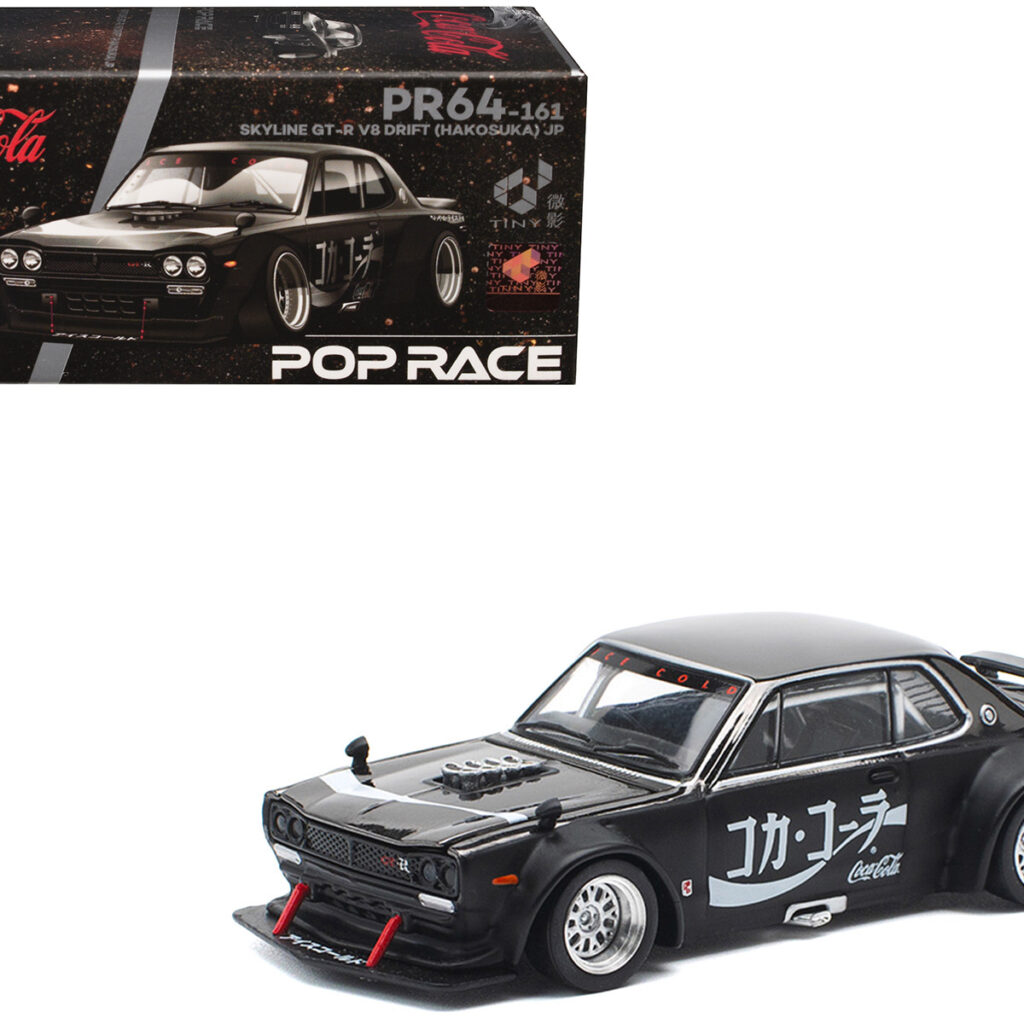
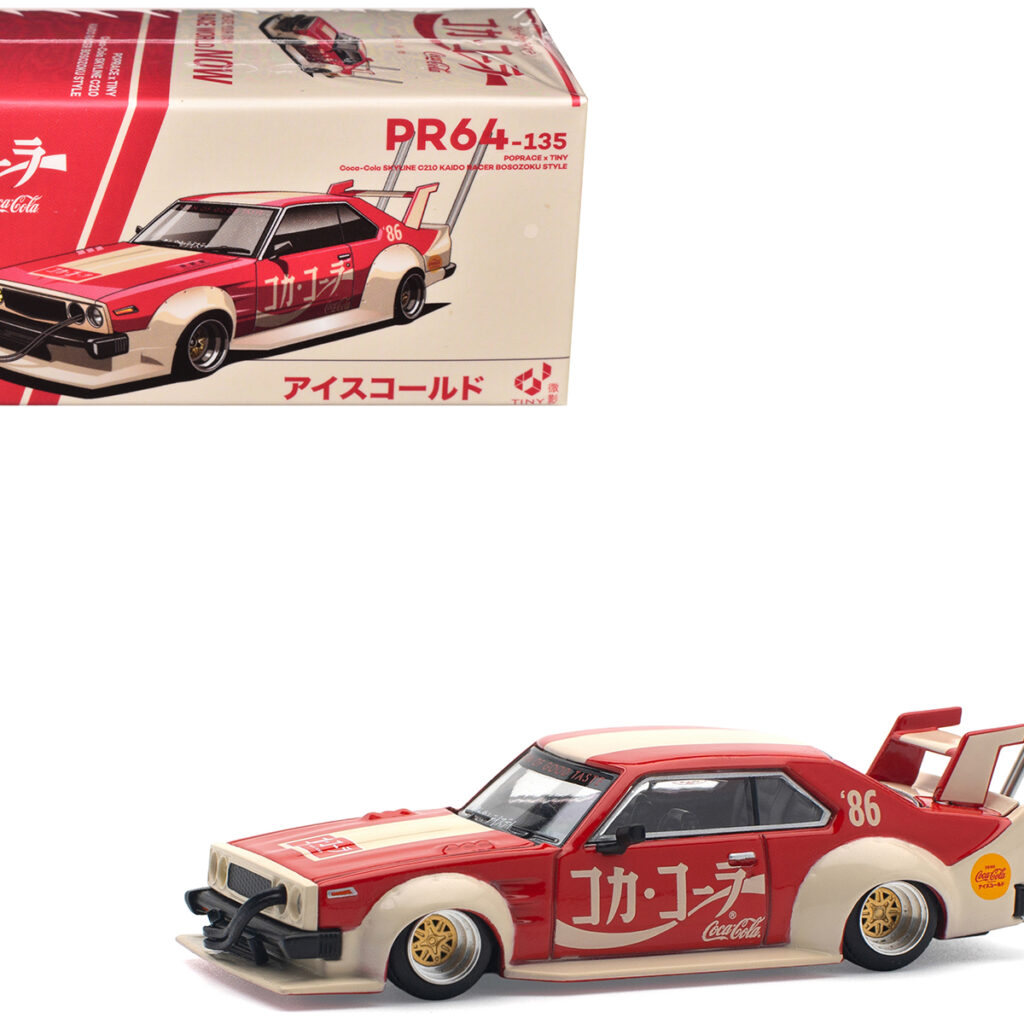
The Pop Race entries, specifically the two Skyline GT-R V8 Drift Hakosuka models at 1/64 scale, are the most internationally oriented pieces in the collection. The Hakosuka, a nickname for the first-generation Nissan Skyline GT-R produced between 1969 and 1972, is one of the most beloved and collectible Japanese vehicles in the global automotive culture, particularly in the drift and racing communities that have elevated it to iconic status. The Coca-Cola Black Hakosuka at $30.86 and the Coca-Cola Japan Red and Cream version at $25.99 both feature right-hand-drive configurations that are accurate to the Japanese market specification, and the combination of the GT-R’s aggressive sporting character with Coca-Cola branding reflects the brand’s deep cultural penetration into the Japanese market, where it has been one of the most recognized foreign products for decades.
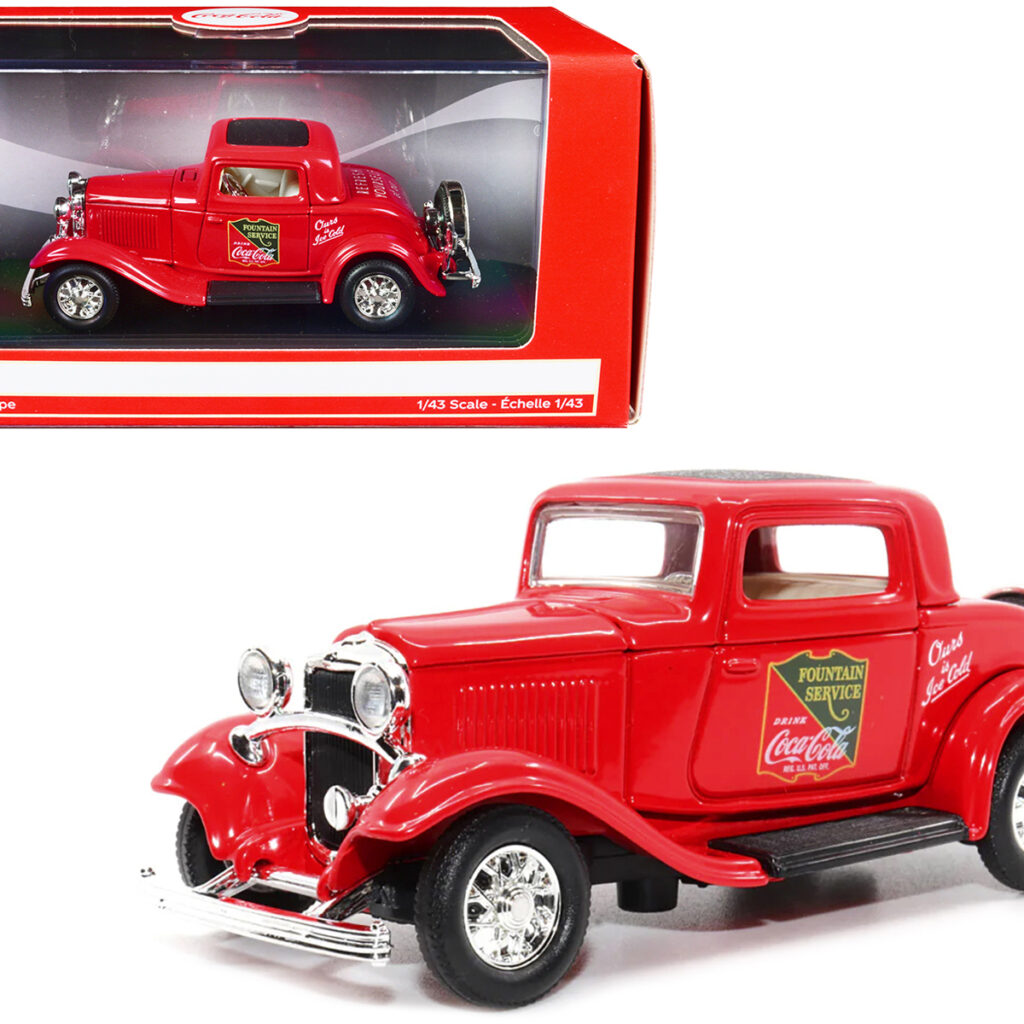
The medium-scale Motorcity Classics offerings occupy the mid-range of both price and display size. The 1934 Dodge KH-32 Streamline Fountain Truck in Cream at 1/43 at $29.17 is historically distinctive, representing a specialized vehicle type, the fountain service delivery truck, that was purpose-built for the fountain drink distribution market at a time when the soda fountain was still one of the primary points of sale for Coca-Cola. The 1945 Panel Delivery Van Coca-Cola Red at 1/43 at $24.62 and the 1962 Volkswagen Coca-Cola Cargo Van Red at 1/43 at $27.35 represent both the domestic and internationally produced commercial vehicles that carried Coca-Cola into the postwar marketplace. The 1932 Ford Coupe Coca-Cola Red with Black Top at 1/43 at $27.35 brings the Depression-era hot rod classic into the collection at 1/43 scale. The 1967 Volkswagen Beetle Red with Teardrop Travel Trailer at 1/43 at $31.90 is one of the more charming narrative compositions in the collection, pairing the era’s most beloved economy car with a teardrop trailer in a combination that evokes the American road trip culture of the late 1960s. The 1960 Routemaster London Double Decker Bus at 1/64 at $21.89 takes the collection outside the American automotive tradition entirely, reflecting the brand’s British presence through one of the most recognizable transit vehicles in the world.
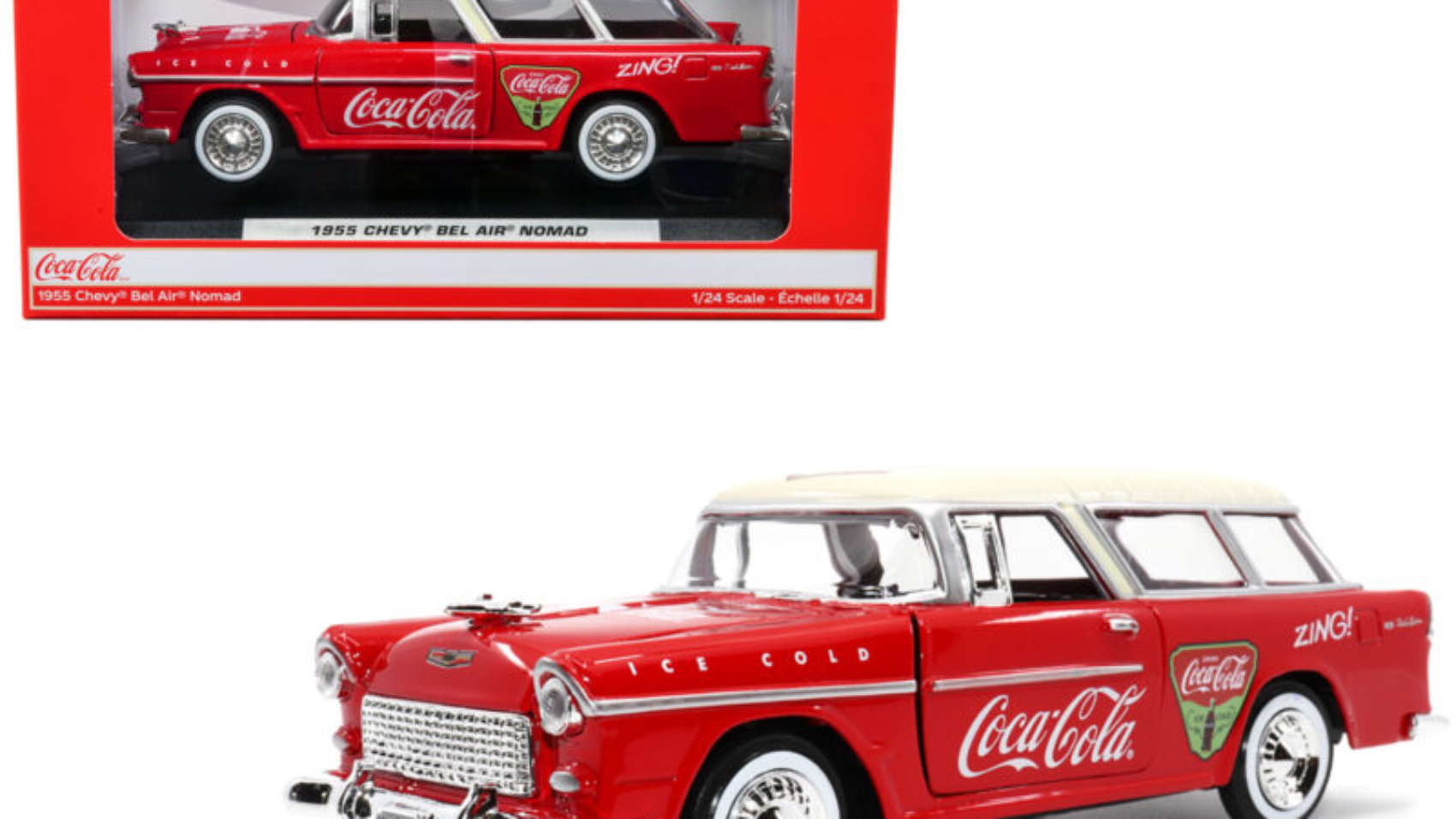
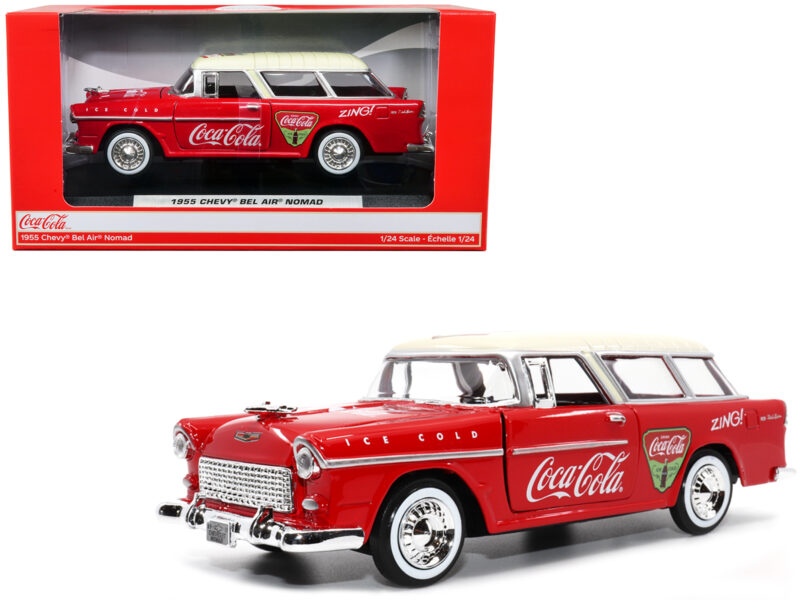
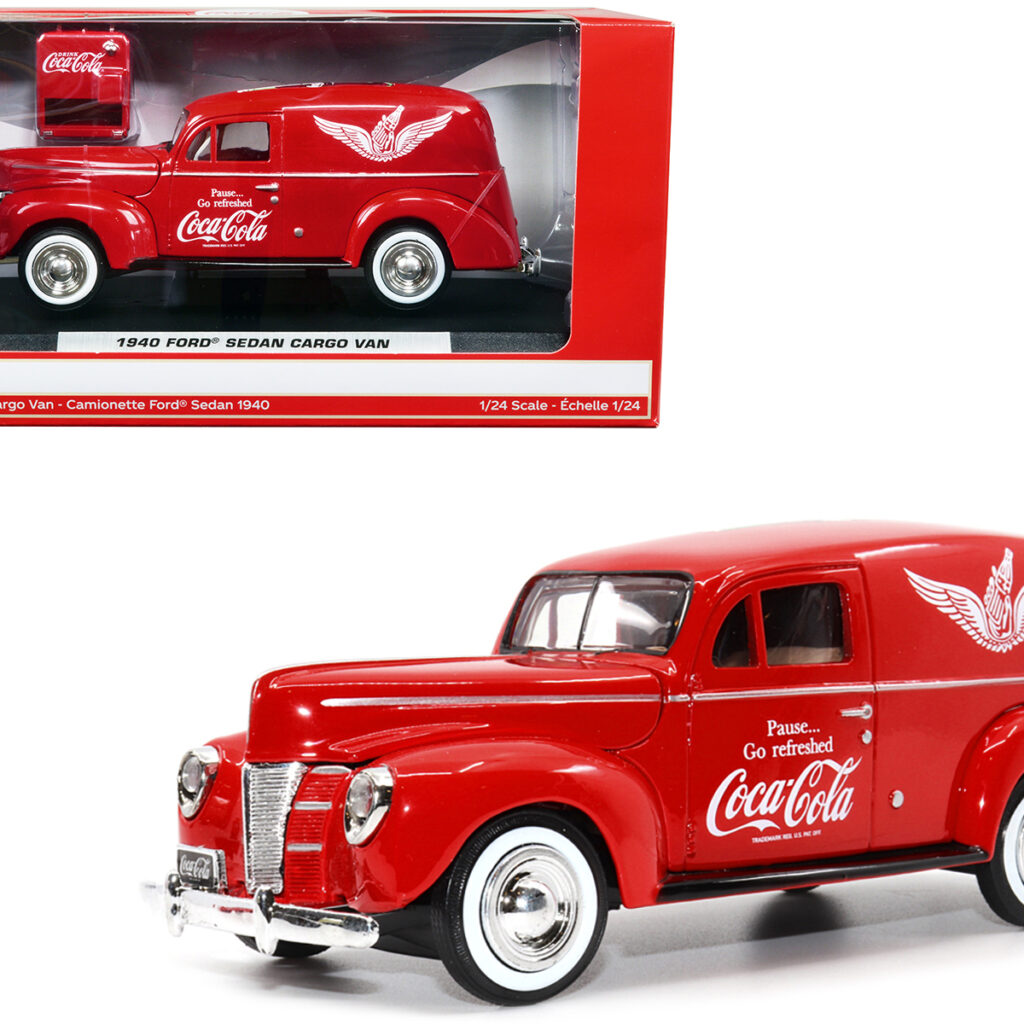
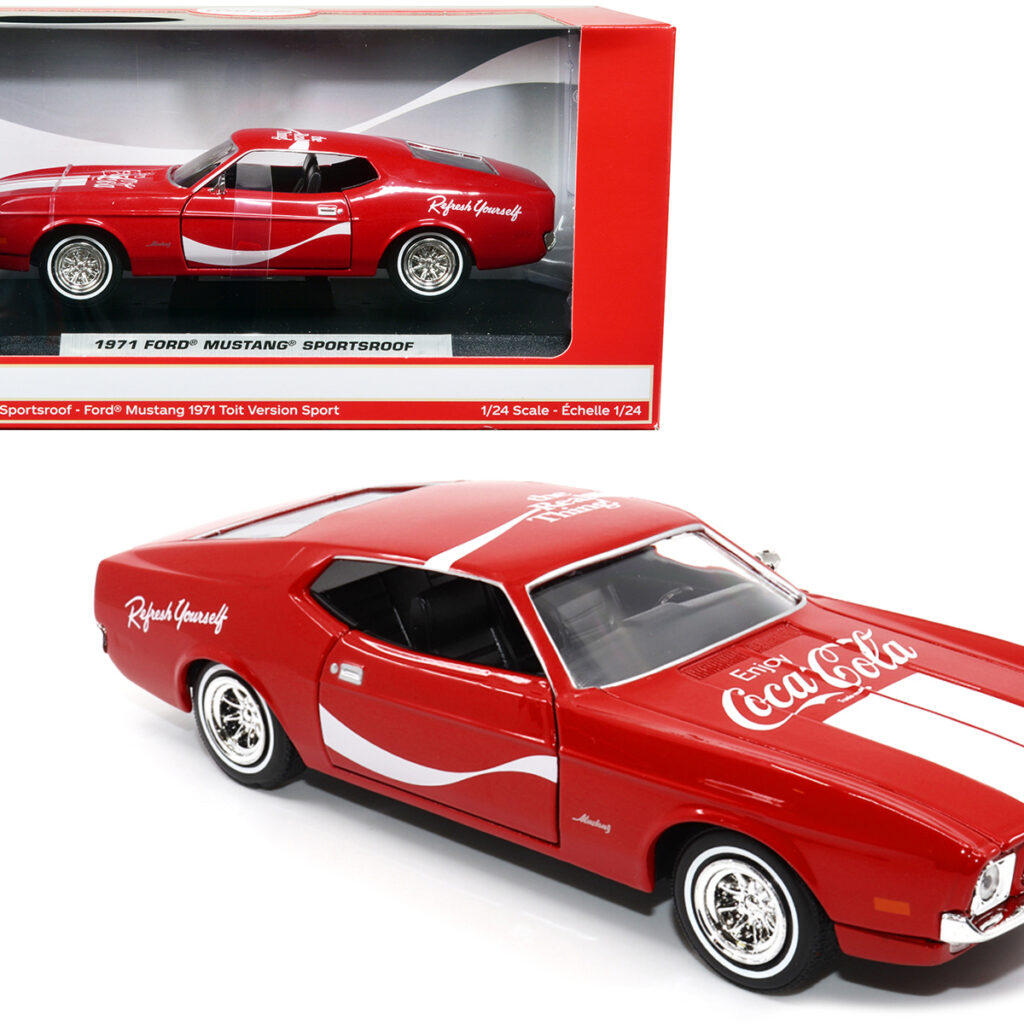
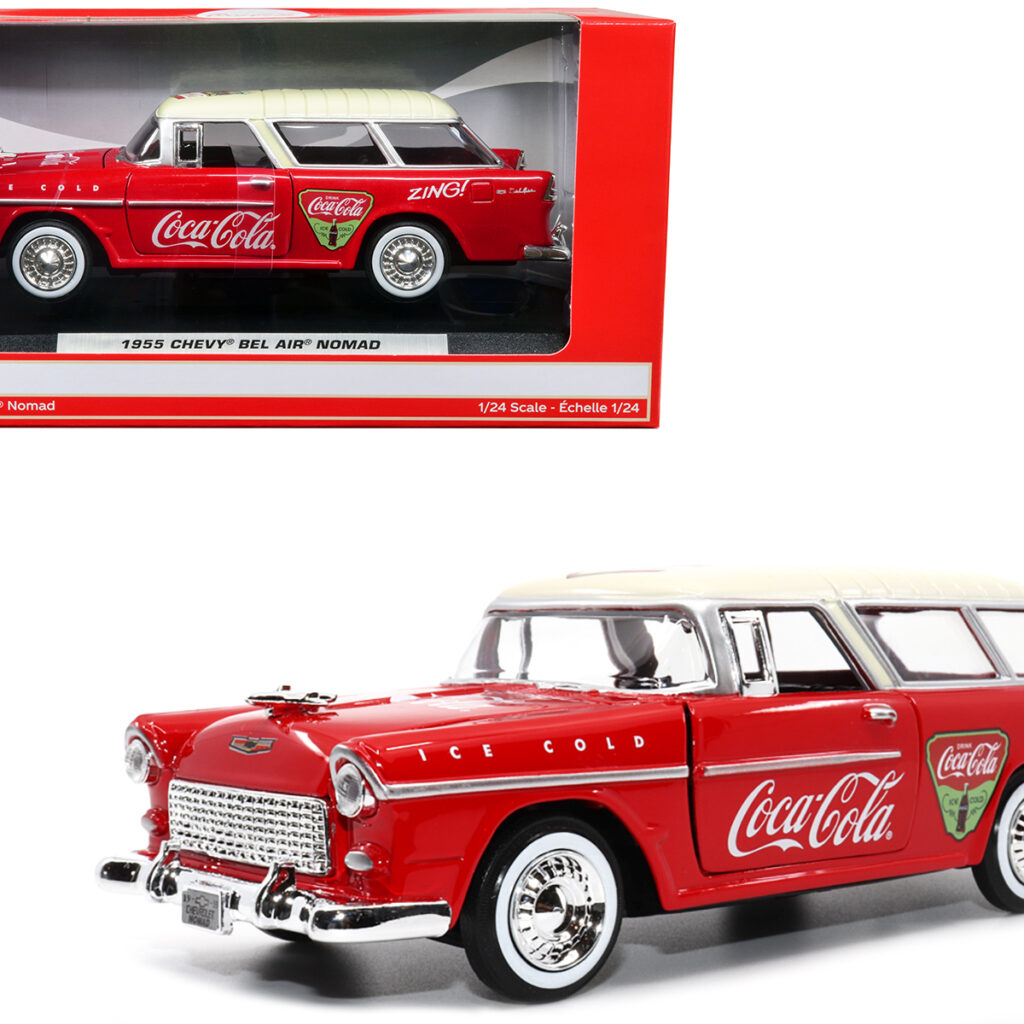
The larger 1/24 scale Motor City Classics pieces represent the collection’s most display-dominant diecast offerings, with dimensions that command any shelf or display case they occupy. The 1940 Ford Sedan Cargo Van Red with Vending Machine Accessory at $49.39 carries the “Pause, Go Refreshed” slogan on a 1/24 scale rendering of the same Ford delivery body that appears in the AMT model kit lineup, allowing collectors to compare the ready-display and build-it-yourself approaches to the same historical vehicle at roughly the same final scale. The 1971 Ford Mustang Sportsroof Red with White Stripes at $49.39 bearing the “Refresh Yourself” tagline is one of the most visually dramatic pieces in the entire collection, combining the fastback Mustang’s aggressive roofline and muscular proportions with Coca-Cola’s classic red and white color scheme in a combination that captures the American automotive culture of the early 1970s with precision. The 1955 Chevrolet Bel Air Nomad Red with White Top at $49.39 renders one of the most beloved American station wagons ever produced, a car that combined the Bel Air’s iconic two-tone styling with a wood-paneled wagon body in a format that has become one of the most collected American vehicles of the postwar period.
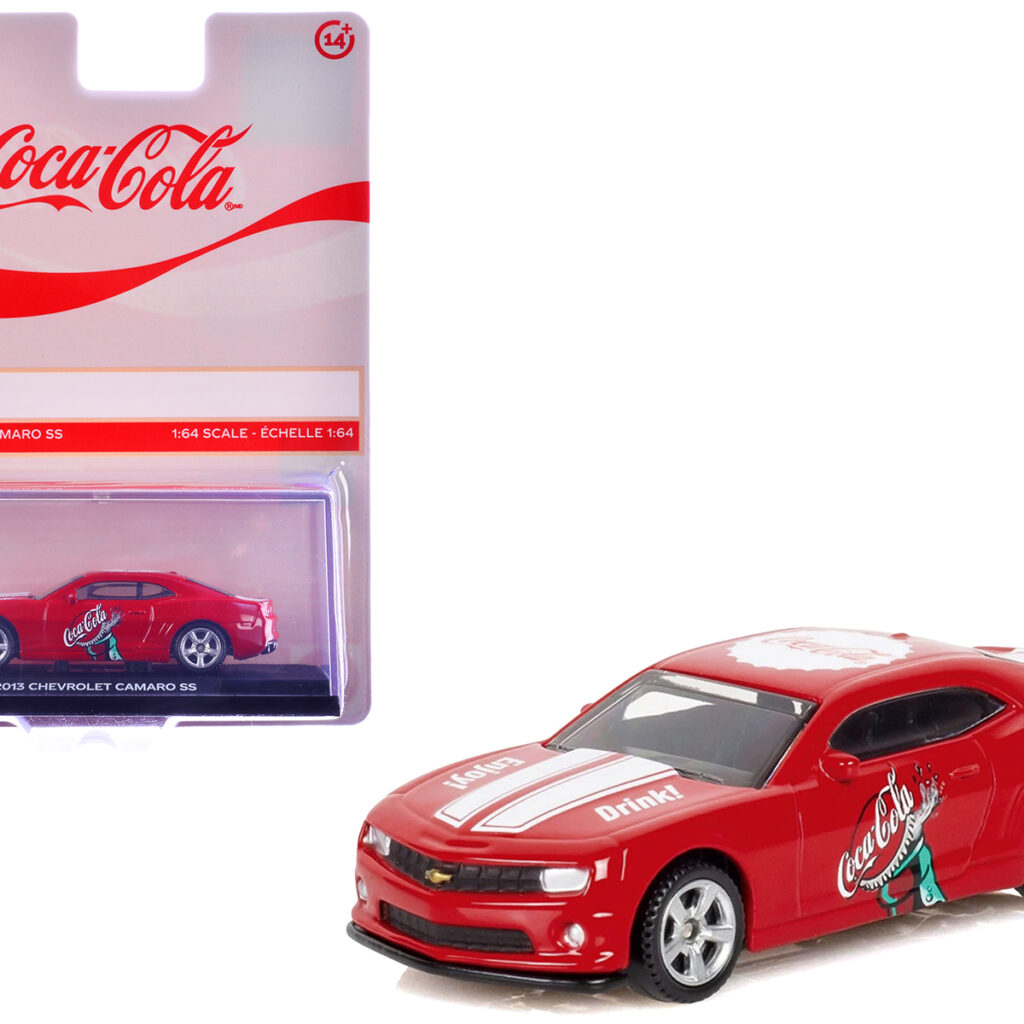
The two Motorcity Classics 1/50 scale pieces serve the collector who wants something larger and more display-commanding than the 1/64 and 1/72 pieces without committing to the full 1/24 format. The Truck Tractor with 53-foot Trailer Drink Coca-Cola Red and White at $57.58 is the most comprehensive commercial vehicle model in the collection, capturing the full highway transport configuration with tractor and trailer together at a scale that allows meaningful detail to be rendered in the finished piece. The Beverage Delivery Truck with Handcart and 4 Bottle Cases at $49.45 is the collection’s most evocative narrative piece at any scale, combining the delivery truck with the handcart and four individual Coca-Cola bottle cases that together recreate the complete delivery scenario that played out at American soda fountains, restaurants, and grocery stores throughout the mid-twentieth century. The handcart and bottle cases are separate and distinct from the truck itself, making the assembled display something approaching a miniature tableau rather than simply a vehicle on a shelf. The 1917 Ford Model T Cargo Van Coca-Cola Red with Black Top at 1/24 at $41.72 takes the collection back to the very earliest years of automotive commercial distribution, when the Ford Model T was the vehicle that made motorized delivery economically accessible to American businesses and Coca-Cola was still consolidating its national presence from its Atlanta base, and the 2013 Chevrolet Camaro SS Coca-Cola Red with White Stripes at 1/64 at $15.59 brings the collection all the way into the modern era with the fifth-generation Camaro, connecting Coca-Cola’s visual identity to one of American muscle car culture’s most celebrated modern expressions.
The Vending Lot: The Right Home for This Collection
The Vending Lot’s Coca-Cola collection at Popular Brands exists within an ecosystem of officially licensed entertainment and cultural merchandise that has been built with exactly the kind of curatorial intelligence this collection requires. The Vending Lot is not a general marketplace that happens to carry some collector’s items alongside unrelated consumer goods. It is a dedicated entertainment merchandise destination organized around specific cultural properties, and the decision to build a comprehensive Coca-Cola diecast and model kit collection reflects the same understanding that drives every category the store carries: that the properties with the deepest cultural roots generate the most committed collector communities, and that those communities deserve access to the best available products presented with the context those products require.
The Film Studio Lot carries officially licensed merchandise for hundreds of theatrical properties. The Merch Stand houses one of the most extensive music merchandise collections available through any single destination, covering over 250 artists across every genre and era. The TV Studio Store covers scripted television from network classics to contemporary streaming. On Broadway serves the stage production community. Funko Town brings collectible vinyl figures from across the entertainment world together with the same attention to quality and cultural specificity. The Vending Lot newsletter on Substack is the direct connection to new arrivals, product features, and the cultural context that makes merchandise genuinely meaningful for the collectors and fans who want more than a product listing.
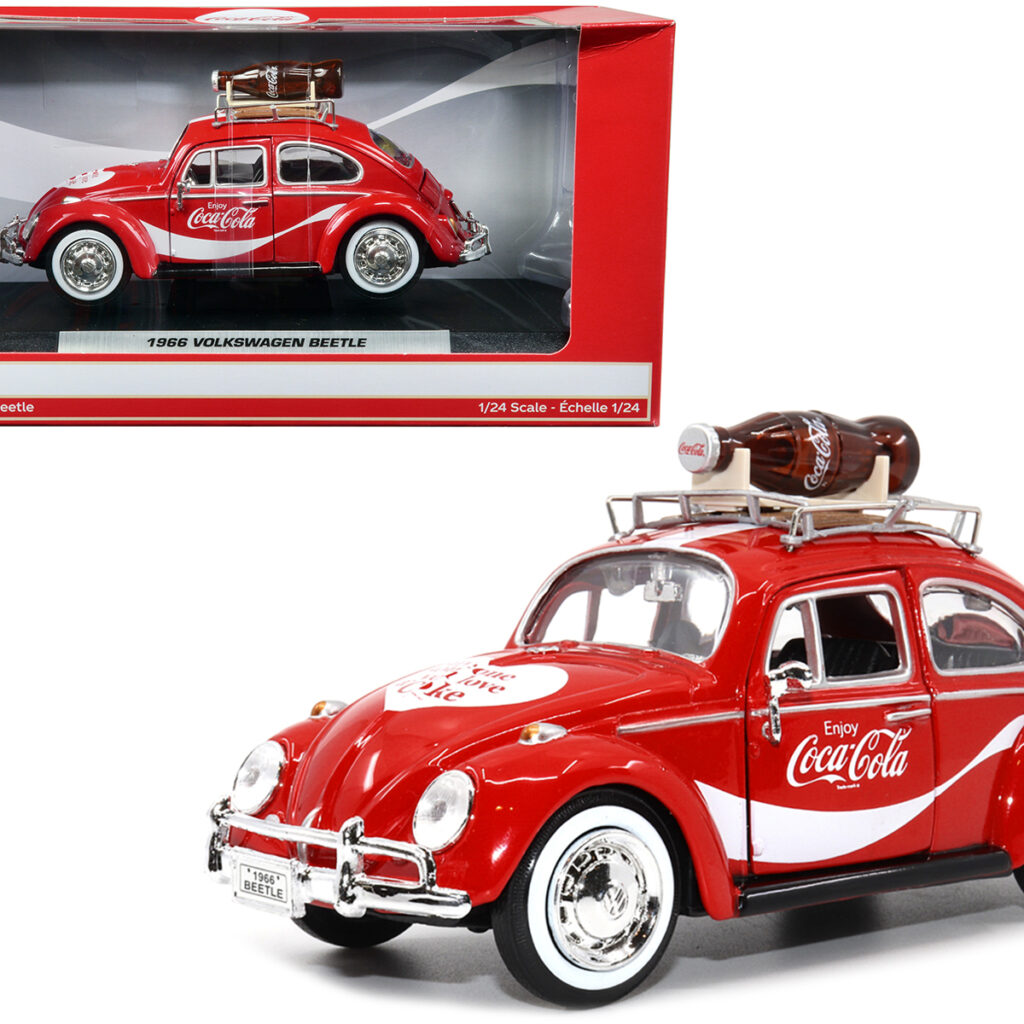
The Coca-Cola collection, spanning 31 products from $14.61 to $61.54, from 1/87 scale delivery trucks to 1/25 scale semi tractors ready to be built, represents the kind of commitment to a single cultural property that only a store with genuine curatorial conviction can sustain. Every piece in the lineup tells a specific chapter of the story: the 1917 Model T that delivered Coca-Cola before most American roads were paved, the 1932 Ford that survived the Depression, the 1955 Bel Air Nomad that carried the brand into the prosperity of the postwar boom, the 1966 VW Beetle that connected the brand to the counterculture era, the 1971 Mustang that gave it American muscle, the Hakosuka GT-R that showed how far the brand had traveled from Atlanta. Together, they form not just a collection but an argument: that the history of Coca-Cola is inseparable from the history of the vehicles that carried it, and that owning that history in miniature is one of the most satisfying forms of collector engagement available to anyone who takes both automotive history and cultural history seriously.
Big Brother premiered its twenty-eighth season on Thursday, July 9, 2026, on CBS and Paramount+, and it did not ease into the summer quietly. Within days of the premiere, the show had announced a casting expansion that shocked even veteran viewers, introduced a house design unlike anything the franchise has attempted before, and generated the kind of live feed drama that reminds everyone why this show has sustained a dedicated, obsessive fan base for over two decades. The season is also carrying a milestone that no American primetime series has ever reached: during this run, Big Brother will officially become the first primetime show in U.S. television history to air 1,000 original episodes.
It is the kind of number that belongs in the same conversation as the most durable institutions in entertainment history, and the franchise has earned it by doing something most reality competition formats never manage to do, which is to keep genuinely reinventing itself rather than simply recycling the same mechanisms with new faces. Season 28 is evidence of that reinvention in real time, with a theme, a cast composition, and a set of gameplay dynamics that are already producing some of the most talked-about moments in recent Big Brother memory. At The Vending Lot’s TV Studio Store, the Big Brother collection carries 21 officially licensed products across multiple seasons, built for the fans who want to wear and use their connection to this show in ways that last long after any given eviction night.
The season’s theme is “Big Brother: Time Trip,” and the entire physical environment of the house has been built around a time-travel concept executed at a level of design ambition that the show has rarely matched. Rooms are styled after different historical eras. The houseguests sleep in pods designed to evoke the future. A hallway features what the show calls failed inventions from past seasons, including a deliberate callback to the infamous Time Laser from Season 25, which will land as a knowing wink for anyone who followed that season’s endlessly discussed twist mechanics. Time is not just an aesthetic choice here. It functions as an active disruptor within the gameplay itself through Time Capsule challenges, which can alter the rules mid-competition, distribute unexpected powers drawn from either the past or the future of the game’s own history, or impose punishments that shift the balance of the week in ways contestants cannot anticipate. The result is a season where the uncertainty is genuinely structural rather than manufactured through a simple double eviction or a twist telegraphed in the premiere week press release.
The casting for Season 28 expanded from an initial roster of 14 houseguests to 17 total after producers dropped a series of surprise additions during premiere week, and those additions have already reshaped the game’s social architecture in fundamental ways. The most significant of those additions came from a direct pipeline into Survivor fandom. Rick Devens, the beloved and strategically sharp contestant from Survivor: Edge of Extinction, and Dee Valladares, the winner of Survivor 45, both entered the house as surprise competitors and almost immediately found each other, forming what quickly became known as the “Crossover” alliance. The pairing makes obvious sense from a gameplay standpoint: both players arrived with experience in a related but distinct social strategy game, with transferable skills around reading rooms, managing jury perception, and executing calculated moves without leaving obvious fingerprints. For Big Brother fans who have followed Survivor, and for Survivor fans who have followed Big Brother, the crossover element gives Season 28 an audience bridge that the show has not had in recent memory.
Angela Murray entered as the season’s returning player, arriving with a reputation forged during a controversial and memorable run on Season 26. She is the kind of houseguest who polarizes a fanbase cleanly: some viewers regard her as a compelling strategic force whose bluntness is a feature rather than a bug, while others consider her a destabilizing personality whose presence changes the social chemistry of whatever room she occupies. That division is exactly why producers bring players like Angela back, because division generates engagement, and her return has already proven that calculus correct. The fight that erupted over the weekend between Angela and Jason De Puy on the live feeds became one of the most discussed moments of the early season, with Angela accusing De Puy of intense emotional manipulation in a confrontation that exposed fracture lines in multiple alliances simultaneously.
Jason De Puy is one of Season 28’s most distinctive presences for reasons that extend beyond the drama he has generated with Angela. He is a well-known drag performer who competed under the name Salina EsTitties on RuPaul’s Drag Race, which gives him a public profile and a fanbase entering the game that most houseguests never have access to. The strategic implications of that visibility cut both ways: he walked in with passionate supporters who are invested in watching him succeed, but also with a recognizable identity that makes him a natural early target for players who see an obvious jury threat from the first week of competition. The cast also includes Lyric Medeiros, an American Idol alumna whose musical background and performance instincts give her a specific kind of social presence in the house, and Drew Campbell, who competed on Beast Games, the high-stakes survival competition series, bringing yet another reality television credential into the mix. Mallory Aurichio rounds out the roster’s most unexpected detail: she is a rocket scientist, a fact that was revealed to the other houseguests only after the first eviction, when a stunned Ashley Trail learned her former housemates’ real professions upon her exit. Ashley, a bartender, was voted out in a unanimous 14-0 decision in the season’s first eviction, making her departure one of the more lopsided and unsentimental opening exits in recent franchise history.
Week 2 has moved the season into genuinely dramatic territory at a pace that is making the live feeds essential viewing. Rick Devens won both the Head of Household competition and the Power of Veto back-to-back, giving him an extraordinary amount of control for a single week and effectively making him the most powerful player in the game at this stage of the season. He has used that power to construct what is being called the “Toolshed” alliance, a merger of the Red Corner and Crossover factions into a larger mega-alliance that currently commands enough numbers to function as a genuine majority. His nominations for the week placed Jason, Lyric, and Melody on the block, but the strategic target Devens has been working toward is a backdoor move against Rome Seymour, a pickleball coach who has been quietly building his own coalition on the opposite side of the house. The backdoor plan requires the right combination of Veto outcomes and alliance cooperation, and whether it succeeds will likely determine the power balance of the next several weeks.
The storyline surrounding Devens extends into a territory that no previous Big Brother contestant has ever occupied, and it has generated coverage far beyond the reality television press. Director James Gunn disclosed on Threads that Devens had been scheduled to appear in a cameo in Superman before the show began filming. Because Devens entered the Big Brother house before that cameo could be recorded, and because the rules of the game prevent houseguests from leaving, the cameo had to be canceled. The detail landed as both a funny real-world collision between two very different entertainment universes and a testament to how seriously the game takes its own isolation requirements. It has also introduced Big Brother Season 28 to audiences who might not otherwise have been tracking the show’s summer run, generating a wave of coverage that connects the franchise to one of the most anticipated superhero films of the year.
The 1,000-episode milestone that Season 28 will reach during its run deserves more than a passing mention, because what it represents is genuinely unusual in the landscape of American broadcast television. Big Brother premiered on CBS in the summer of 2000, drawing heavily from the Dutch format that had launched internationally a year earlier, and it spent its early seasons finding the specific combination of live feed access, competitive structure, and social gameplay that would distinguish it from every other reality format of its era. The live feed model was central to that distinction from the beginning: unlike other reality competitions where audiences saw only what the editing room decided to show, Big Brother gave devoted viewers continuous access to the house through an unedited live stream, creating a secondary audience of superfans whose engagement with the show operates on an entirely different level of intensity than casual primetime viewers. Those superfans have been the engine of the show’s cultural durability for twenty-six years, and the 1,000-episode milestone belongs as much to them as to the network or the production team.
No other American primetime series has reached this number of original episodes. The comparison point that makes this statistic meaningful is not just longevity in terms of seasons but total original episode output, which reflects both the show’s consistent annual schedule and its multiple-episode-per-week format that produces more programming hours per season than most scripted dramas. Big Brother airs multiple times a week throughout the summer, and live eviction shows, competition results episodes, and the Sunday night recap format together generate a volume of content that accumulates across twenty-eight seasons into a number that is, by any measure, a historic achievement for American broadcast television.
The Vending Lot’s Big Brother collection carries 21 officially licensed products spanning Seasons 26 and 27, built across a range of product categories that cover every way a Big Brother fan actually engages with the show in their daily life. The apparel lineup includes some of the most compelling pieces in the collection. The Big Brother Season 27 Champion Hoodie is priced between $72.13 and $89.98 depending on size and variant, built by Champion, whose legacy in American athletic and lifestyle apparel makes it one of the most trusted fabric and construction choices in officially licensed fan merchandise. Champion’s hoodies are known for the weight and durability of their fleece, and the Big Brother branding on this piece is applied to a garment that wears well through the full span of the show’s summer broadcast window. The Big Brother Season 27 Adidas Unisex Fleece Crewneck Sweatshirt, priced between $84.98 and $94.98, brings Adidas’s quality standards to the same officially licensed Big Brother aesthetic, making it the collection’s premium sweatshirt option for fans who want the global sportswear brand’s construction and fit alongside their fandom.
The Big Brother Season 27 Unisex Distressed Cap at $34.98 adds a headwear option that works with essentially any casual outfit, carrying the Big Brother branding in a worn-in, vintage-feeling format that suits the show’s summer cultural identity.
The drinkware and lifestyle accessories in the collection are among the most practically useful pieces The Vending Lot carries for any property, and the Big Brother lineup is particularly well developed in this category. The Big Brother Season 27 Insulated Tumbler in 30oz is priced between $46.65 and $49.98 and is the size most suited to the serious live feed viewer who is settled in for a long session. The insulated construction keeps drinks at temperature whether you are watching the evening CBS broadcast or refreshing the Paramount+ feed at two in the morning waiting for a late-night backdoor conversation. The Big Brother 26 Insulated Tumbler in 30oz at $49.98 and the Big Brother 26 Insulated Tumbler in 20oz at $49.98 provide the Season 26 visual design for fans who want that specific season’s branding. The Big Brother 26 Vagabond 20oz Tumbler at $34.98, the Big Brother Ringneck Tumbler in 20oz at $34.98, and the Big Brother 26 Skinny Tumbler in 22oz at $49.98 each offer distinct tumbler formats at slightly different price points, giving the collection meaningful variety in this category rather than simply repackaging the same product with different artwork.
The Big Brother Season 27 Colorful Mugs are available in both 11oz and 15oz formats between $24.98 and $29.98, making them the collection’s most accessible drinkware option and a genuinely useful everyday piece for the fan whose Big Brother fandom follows them into the morning coffee routine. The Big Brother 27 Jewelry Box at $64.98 is one of the more distinctive items in the entire collection, a functional storage piece that carries the season’s visual identity into a format usually reserved for the most personal and daily-use items in someone’s home. The Big Brother 27 HOH Long Sleeve Kimono Robe and the Big Brother 26 HOH Long Sleeve Kimono Robe are both priced at $44.98 and are among the most literally in-game pieces of merchandise in the collection, referencing the Head of Household robe that is one of Big Brother’s most recognizable visual symbols and one that carries a specific meaning for any viewer who has watched the show’s HoH reveal moments for any length of time. The Big Brother 27 Duffel Bag and the Big Brother 26 Duffel Bag are both priced at $74.98 and are the collection’s most functionally substantial pieces, full-size carry bags that serve a genuine travel and gym purpose while carrying the Big Brother branding. The Big Brother 26 Beach Towel at $39.98 and the Big Brother 26 Boho Beach Cloth at $69.98 connect the show’s summer schedule to the actual season of the year in which it airs, outdoor pieces for the summer months when the show is on the air and the audience is, to the degree possible, spending time outside while mentally processing whatever happened on last night’s episode.
The breadth of this product lineup reflects something genuine about the Big Brother audience. This is a show with one of the most committed superfan communities in American television, a group of viewers who not only watch the broadcast episodes but maintain active monitoring of live feeds, engage deeply in online communities analyzing strategy, and form parasocial relationships with houseguests that persist across years. Those fans want to express their connection to the show in every format of their daily lives, from what they wear and what they drink from to what they carry their things in and how they organize their personal space. The Vending Lot’s 21-product Big Brother collection addresses that desire at every level.
The TV Studio Store at The Vending Lot carries more than 1,250 products across hundreds of television properties, from classic broadcast network series and beloved sitcoms to contemporary streaming prestige dramas, procedurals, animated franchises, and the reality competition genre that Big Brother has led for a generation. The Big Brother section sits within that wider context as one of the store’s most developed reality television collections, a reflection of the show’s cultural weight and its audience’s demonstrated commitment to fan merchandise. The Film Studio Lot, the Merch Stand, On Broadway, and Funko Town extend The Vending Lot’s coverage across cinema, music, live theater, and collectible figures with the same intentional curation that defines the TV Studio Store’s approach to properties like Big Brother. The Vending Lot newsletter on Substack is the direct line to new arrivals, product drops, and the context that makes each collection meaningful for subscribers who want the full story behind what the store carries.
Big Brother Season 28 is airing now, the Time Trip twist is already disrupting alliances, Rick Devens is playing at a level that makes the live feeds essential, Angela Murray’s presence is generating exactly the kind of conflict that drives conversation, and the 1,000-episode milestone is approaching during a season that feels genuinely worthy of the occasion. The full Big Brother collection at The Vending Lot is available now for the fans who want everything the store can offer alongside everything the show is delivering this summer.


 Cart is empty